Farms.com Home   Ag Industry News

The Ford 8N is a classic for a reason

A review of uses and comments on repairs.

IN THE SHOP with Rachel

By Rachel Gingell

Built from 1948 to 1952, the Ford 8N is one of America’s most loved tractors. More than 500,000 were manufactured and many (and their close cousins, the Ford 9N and the Ford 2N) are still in use today.
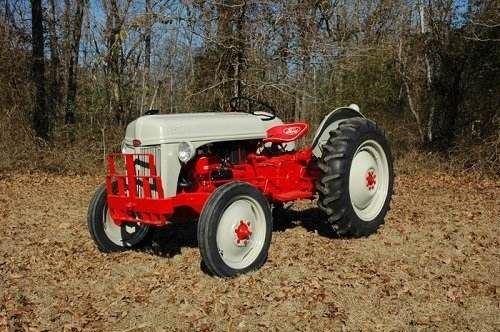
Ford 8N

The Ford 8N can’t do everything. It’s a lower horsepower tractor. There’s no power steering. The hydraulics and PTO are not live. It’s a simple, basic tractor without many of the modern conveniences you’d get in a new tractor today. What you DO get in the Ford 8N is rugged reliability at a low price.

There are plenty of small chores around the farm for which the Ford 8N is perfect. The three-point hitch makes it a versatile tool. I use one frequently for blading the driveway, brush hogging, and pulling a wagon to and from the woodpile. It’s also great for hobby farmers or someone who wants to plant a small feed plot to attract wildlife.

The Ford 8N is the standard of reliability, built to last for generations. While these tractors do require occasional maintenance, there are no significant design flaws that would make this tractor unreliable.

These tractors are easy to work on. It’s an excellent first tractor for a budding mechanic, with a straightforward design and easy-to-find parts. In fact, I can’t think of a single part on the 8N that can’t be replaced with an aftermarket part. The laws of supply and demand really work for you with an 8N tractor! With so many of these machines still in use, the price and availability of parts can’t be beat.

You can have a lot of fun with a Ford 8N, too! My dad and I worked together one year to put a flathead V8 in an 8N Ford. We liberated the perfect 4.3 Chevy engine from an old Astro van that we found at my uncle’s salvage yard. While an Astro isn’t exactly the most impressive of vehicles, the engine got a whole new lease on life inside that tractor!

If you are looking for an inexpensive, rugged, reliable tractor for basic chores, the 8N can’t be beat.


Trending Video

Western Canadian Agriculture: Hard Times Made the World's Best Farmers

Video: Western Canadian Agriculture: Hard Times Made the World's Best Farmers

Western Canadian agriculture produced the most advanced farmers in the world not through abundance but through adversity. The crow rate fell. The wheat price went nowhere. The brown envelopes stopped.

When the subsidies disappeared, the bad farmers left and the good ones stayed. And the ones who stayed could not just grow wheat anymore. They started growing lentils and canola and peas and flax and faba beans. They built crop rotation. They got serious about agronomy because there was no government backstop. That process produced the Western Canadian agriculture Dennis Bulani describes in this clip: the most advanced, most educated farming culture in the world.

His contrast with Iowa corn and soybean farmers is sharp. At a DeKalb farmer meeting in Okoboji, Iowa, he asked what crop rotation they ran. Beans on corn stubble, corn on bean stubble. How do you fertilize? The co-op agronomist handles it. Have you considered other crops? No need. We make so much money on corn and soybeans. Western Canadian agriculture was never allowed that comfort. And now those Iowa farmers are watching soybean markets lock up with China and corn prices slide, and they do not have the agronomy knowledge or the research base to pivot. Western Canadian farmers adapted on a dime because they had done it before.

Dennis also makes the case that Western Canadian agriculture keeps adapting in real time. Low commodity prices over the past year have pushed growers to look seriously at precision spot-spray technology. He knows a neighbor who bought a sprayer with the seeing-eye system and sprayed only 80 out of 320 acres. As a chemical retailer Dennis acknowledges that will affect his sales. He supports it anyway, because if it advances Canadian agriculture and makes farmers money, that is a good outcome.

The lesson Dennis draws from the tale of two farms: continuous improvement is the only durable strategy. When canola was $22 a bushel some growers went to Arizona instead of the Crop Production Show. When the price came down those same growers came back to the research and the discipline. Products do not go on Rack Petroleum's shelves unless they pass a replicated trial first. That is what Western Canadian agriculture built through hard times: farmers who do the work whether the times demand it or not.

Dennis Bulani is CEO of Rack Petroleum and Ultimate Yield in Biggar, Saskatchewan. Dan Aberhart hosts GTF Productions, Western Canadian Agriculture's foremost live briefing platform and its foremost AI training platform for ag operators