A popular choice for tractor pulls
IN THE SHOP with Rachel
By Rachel Gingell
Farms.com
The John Deere G is the highlight of the John Deere two-cylinder tractors, cranking out a full 20 horsepower (31 at the belt). What the tractor lacks in modern conveniences it makes up for in reliability and raw power.
The G was manufactured from 1937 until 1953. This long span of production included models built during the war years of 1942 to 1947 (1944 excluded) with the model designation GM. Those GM tractors were given the M addition to stand for “modernized.” The modernizations weren’t overly significant, though – just enough to convince the wartime production board that the tractor was improved in order to warrant continued production. After the war, the GM reverted back to a simple G.
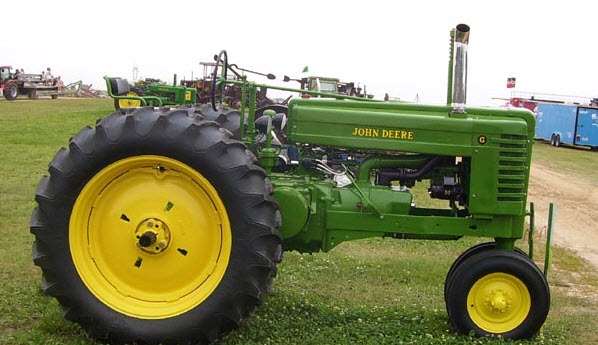
John Deere G
Photo: TractorData.com
Like other letter series tractors, you’ll find three basic versions: a bare-bones unstyled G, a mid-series early styled G, and a final version called the late styled G. Across the versions, the G graduated from a four-speed transmission to a six-speed transmission. Other improvements included a cushioned seat, electric start and lights, and a new location for the serial number plate.
In every iteration of the G, one thing remained the same: the engine. This powerful two-cylinder just cranks out the power. It’s a simple engine and simple is a very good thing! There’s not much to go wrong, making this one of the more reliable basic tractors on the market.
The simple power of this tractor makes the G a very popular choice for tractor pulling. The two-cylinder engine is easy to soup up and it can become very competitive on the pulling track. The lack of bells and whistles means you can strip the tractor down to pull in the 6,000 lb. or even 5,500 lb. weight classes.
You can still get parts and service at your local John Deere dealership. Plenty of aftermarket parts are also available. The straightforward mechanics means that you might be able to do most repairs yourself.