OMAFRA has confirmed clubroot’s first appearances in the province
By Jennifer Jackson
Clubroot can be a costly disease. It has thankfully not impacted Ontario canola growers – until now.
The Ontario Ministry of Agriculture, Food and Rural Affairs received notice that an agronomist working with a grower in Verner, in the West Nipissing District, found clubroot after scouting a poorly growing canola crop in the summer of 2016. OMAFRA’s tests confirmed it was clubroot.
Later in the fall of 2016, this finding drove OMAFRA conduct a wide-scale soil sampling study in the following regions:
- West Nipissing District
- Timiskaming District
- Cochrane District
- Thunder Bay District
- Kapuskasing District
- Wellington County
- Renfrew County
- Lanark County
- Bruce County
- Grey County
- Dufferin County
Of some 95 soil samples, OMAFRA found a total of 11 samples were positive for the disease. In December, OMAFRA declared these positive samples were found in West Nipissing District, Timiskaming District, Bruce County and Dufferin County. Researchers are currently identifying the pathotype of the disease to compare with other strains.
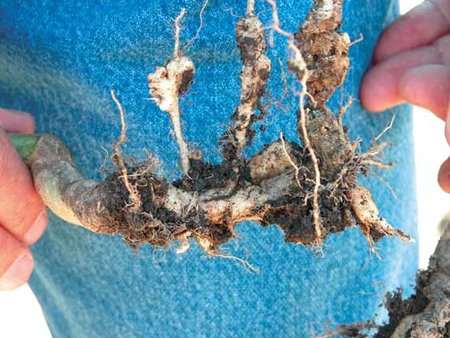
Clubroot galls on a canola plant's root system. Photo credit: Kelly Turkington, Alberta Agriculture and Forestry
The disease affects the root of the canola plant, according to Meghan Moran, canola and edible bean specialist with OMAFRA.
“The symptoms will (appear in plants as) stunting (of growth), wilting and yellowing – you may have areas that are prematurely ripening,” she says. Clubroot “looks similar to other disease and nutrient deficiencies – you will have to go to the (sickly) patches, dig them up and look at the roots.”
If they are infected with clubroot, the roots will have large galls or significant swelling.
“All (canola) growers need to be aware and watch their crops carefully,” Moran says. “The disease cannot be eradicated from the soil.”
Canola acres in Ontario have been declining lately due to increasing pressures from the swede midge, a pesky insect. In 2016, there were approximately 30,000 acres, according to Moran.
She would not like to see the number of acres decline further because of clubroot concerns.
“We do not want growers to think they have to stop growing canola. (In Ontario) we have the luxury of growing lots of crops in rotations – a canola grower could have as many as four crops in a rotation,” she says. “Clubroot (currently) is not very widespread and it’s manageable.”
Preventing the spread of the disease is a large part of management, as the spores that cause the disease exist in the soil.
“Focus on sanitation – you do not want to move any soil from infected fields into non-infected fields. (This means and is not limited to) sanitizing equipment and removing soil from the equipment,” says Moran. “Any way that soil can move, the disease can (also) move,” including foot traffic, and wind and water erosion.
To deal with the diseased field, “have long, four-year rotations that will help keep spores down – you can also plant (clubroot-)resistant varieties.”
Clubroot-resistant varieties are nothing new to western Canada, where the disease is widespread and is becoming resilient to some resistant varieties.
“This (variety effectiveness) will be the next thing to focus on – rotating using different resistant varieties. We need to make sure we are not contributing to the breakdown of those resistant varieties,” says Moran.
OMAFRA will soon release a map of affected areas to help educate producers.
“We want (farmers) to be aware the next time they are scouting.”
For more information, check out Farms.com’s video on using variety selection to manage the disease: http://www.farms.com/videos/crops/canola/video-disease-management-clubroot-115635.aspx