By Apurba Barman and John Palumbo et.al
A new caterpillar pest was found infesting alfalfa fields in Imperial County.
It was first observed in mid-September when pest control advisers brought it to our attention (Apurba Barman and Jon Palumbo). This pest has not been previously observed in low desert. Based on the photo of the larvae Michael Rethwisch (UC Cooperative Extension-Riverside County) identified this pest as alfalfa leaftier, Dichomeris acuminatus (Staudinger, 1876). John Palumbo also found alfalfa fields infested by this pest in Yuma, Arizona area. Subsequently, larvae and adults from a laboratory reared colony were sent out to California Department of Food and Agriculture in Sacramento, and expert there confirmed our initial identification.
Reports from many fields. There were numerous reports of this new caterpillar pest from multiple alfalfa fields throughout the low desert since mid-September based largely on their distinct feeding symptoms, which result in 2 leaves folded or 2-3 leaves tied together to create a shell-like structure, hence the name ‘Alfalfa Leaftier'. Caterpillars feed on leaf tissues living within these structures (Fig. 1).
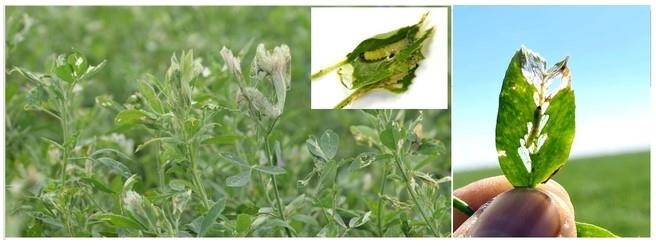
Fig. 1. Damage symptoms in alfalfa crops infested by alfalfa leaftier: leaf folding, loss of green tissues in leaf (leaf sclerotization). (Photo: Apurba Barman)
Hosts Elsewhere. Although not previously reported to damage alfalfa in the U.S., this insect has been found in Hawaii, Florida, Mississippi, and in Southern California (San Diego County) (Moth Photographers Group 2021). It does have a very wide distribution, being reported from wide range of tropical and semi-tropical countries across the globe (northern Africa, most of southern Europe, Australia, India, China, Japan, India, Sri Lanka, as well as many islands). Host plants in additional to alfalfa include various legumes such as sesbania, soybean (Glycine max), pigeon pea (Cajanus cajan), and white clover (Trifolium repens) (Park and Hodges 1995; Ponomarenko 2006; Robinson et al. 2010; Meena et al. 2018,).
Adult alfalfa leaftier moths, being in the same family as pink bollworm moths, are fairly small and are about 8 mm long (Fig. 2), slender, with pale yellowish to orange colored wings that have several dark markings. The wing markings and other structures, which can be used to help identify the moth are shown in figure 3.
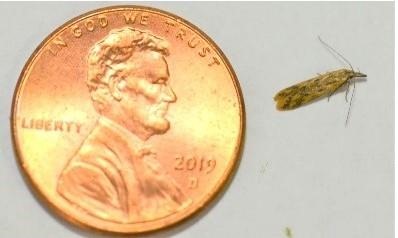
Fig. 2. Adult alfalfa leaftier moth, showing size relative to a penny. (Photo: Apurba Barman)
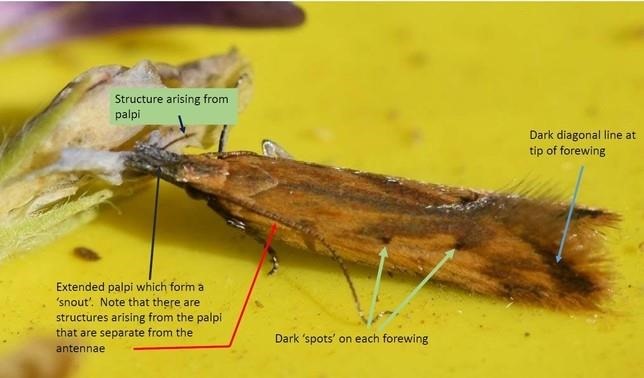
Fig. 3. Adult alfalfa leaftier moth showing markings and other structures important for identification. (Photo: John Palumbo; Illustrations: Michael Rethwisch)
Biology. Females deposit individual eggs on the upper surface of leaves, and are usually pale red in color, small, round with smooth surface. (Fig. 4). Caterpillars are usually light green in color during their early instar stages and may turn yellowish in color towards the last instar, when ready for pupation. Caterpillars are small and somewhat tapered on both ends, with a shiny, black head and a dark, sclerotized first thoracic segment (Fig. 5). Full grown caterpillars can be up to 8 mm long and mostly stay inside the rolled leaf and covered with silken thread as they are ready for pupation. Pupae are usually orange to black in color and about 6 mm long (Fig. 4)
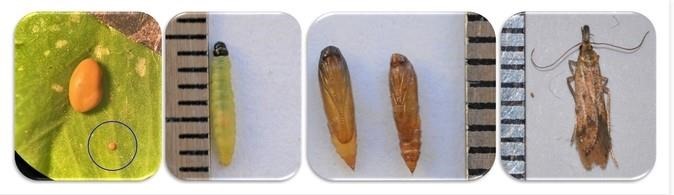
Fig. 4: Egg (inside the blue circle and compared with alfalfa seed), caterpillar, pupa and adult stage of alfalfa leaftier infesting alfalfa, Imperial Co., CA. (Photo: Apurba Barman)
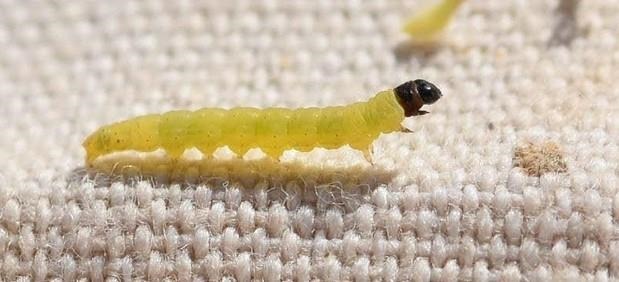
Fig. 5. Alfalfa leaftier caterpillar. Note the completely sclerotized first thoracic segment and leg, as well as 5 sets of prolegs. (Photo: John Palumbo)
Alfalfa hay crops infested with alfalfa leaftier are evident from a distance as the terminal portion of plants are likely to have folded leaves, and often left with dried, white, lower epidermis of the leaves from feeding by the caterpillars. Damage can depend on the number of caterpillars present on the stem and the growth stage of the crop. Under low pest pressure, the damage symptom is usually restricted to the terminal of a plant. However, presence of several caterpillars (3-4 per stem) can result in significant damage to leaves throughout the plant. Based on our observations this fall, heavy infestation of alfalfa leaftier can significantly reduce the hay yield/quality, however, the levels of these reductions have not yet been documented under U.S. low desert alfalfa production conditions.
Thresholds Unknown. Being a new pest for the low desert, no economic thresholds have been established. Anecdotal observations suggest that economic damage from this caterpillar pest appears to be significant if densities exceed one caterpillar per plant. Verification of this level is still needed.
As crops can be infested as early as new leaves appear, fields should be scouted for this caterpillar pest beginning early in the regrowth cycle. During this limited time since the appearance of this pest in the low desert, pest control advisers have treated infested fields with Intrepid® and Prevathon® and found satisfactory control. Further work to evaluate other insecticide products is currently ongoing.
Efficacy of beneficial insects against alfalfa leaftier in the low desert still needs to be studied. Predation of larvae may be greatly restricted due to the sheltering behavior of caterpillars within the rolled leaf structures, however, exposed eggs may be highly susceptible to predation and parasitism.
We would like to hear from farmers and advisors in different regions to understand how widespread this pest may be (please comment in blog).
Source : ucanr.edu