By Adam Varenhorst and Philip Rozeboom et.al
Bean leaf beetles have been observed in numerous soybean fields during the past two weeks.
It’s important to remember that early season scouting for defoliation is important, as the overwintering life stage for bean leaf beetles is adults, and they emerge in the spring with an appetite. In addition, we received some reports of bean leaf beetles actually hunting down soybean seedlings before they emerged. This behavior is unusual and likely due to soybean emergence being behind the bean leaf beetle emergence.
Identification
Adult bean leaf beetles vary in color from brown, orange, yellow, red and varying shades of those colors, with these variations easily observed within a single field. Adults can be identified by the black triangle present behind their thorax.
Adults also have black heads and will generally have four spots on their hardened forewings (elytra), although the distinction of these markings can vary.
Scouting and Management
To scout for early season bean leaf beetles, examine 20 plants in five different areas of the field. Examine plants for the presence of bean leaf beetles, as well as defoliation. The early part of the economic threshold is based on either the number of beetles in three linear feet of the row or the amount of defoliation that is observed. If you are using the defoliation threshold, look for holes in the leaves, as well as feeding on the stems or cotyledons. Management is recommended when an average of 20% of the leaf tissue is removed from the scouted plants.
For bean leaf beetles, the recommended threshold is 20% defoliation prior to flowering, but estimating the percent defoliation on the unifoliate leaves can be difficult. An alternative method is to count the number of adult bean leaf beetles per plant. Table 1 provides the economic threshold for the number of beetles per three linear feet of row based on crop prices and combination of chemical and application costs.
Table 1. Early Season Economic Threshold for Bean Leaf Beetles.*
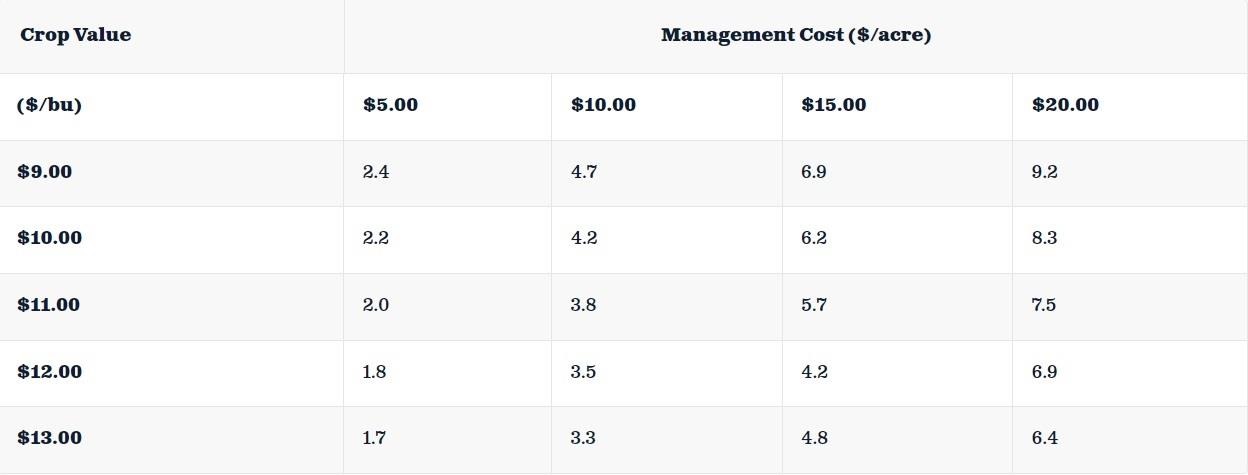
Number of beetles per 3 linear feet (VE to V3). Table modified from data courtesy of the University of Nebraska, Purdue Extension, and Iowa State University Extension.
When scouting bean leaf beetles, it is important to avoid disturbing the plants, as the beetles will often drop to the ground. Avoid casting a shadow on the plants that are being scouted, as that will also cause beetles to drop from the plants.
If the economic thresholds are exceeded, foliar insecticide management is recommended. A list of insecticides labeled for bean leaf beetles in soybean can be found in the latest South Dakota Pest Management Guide: Soybean.
Source : sdstate.edu