By Sarah Lancaster and Vipan Kumar
With row crop harvest well underway, it is time to start planning fall herbicide applications. Herbicide applications in late October through November can improve control of difficult winter annual weeds. Fall weed control is associated with warmer soils and easier planting in the spring, however, it is important to remember that fall-applied herbicides may limit your crop options in the spring. Also remember that herbicides should not be applied to frozen ground.
Some of the key herbicides to consider for fall herbicide applications include Autumn Super, Canopy, Spartan or Authority, and Valor for residual activity. For burndown activity, glyphosate, 2,4-D or dicamba are good options to consider. One thing to keep in mind about residual activity from fall herbicide applications is that weather conditions will influence the length of residual control and the weed emergence patterns. So, even though they provide some residual activity, additional spring application pre-emergence herbicides will likely be needed for season-long weed control.
Some of the key weeds to target with fall herbicide applications are marestail, henbit, dandelion, prickly lettuce, pepperweed, field pansy, evening primrose, and recently-emerged cool-season grasses. When higher rates of herbicides are used, some control of early spring-germinating summer annual broadleaf weeds such as kochia, common lambsquarters, wild buckwheat, and Pennsylvania smartweed can be achieved. Recent data comparing kochia control with fall and spring applications are included in Figure 1.
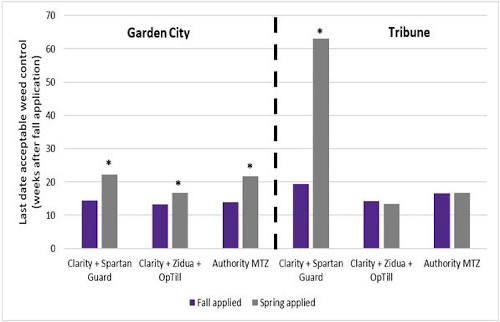
Figure 1. Estimated weeks of kochia control greater than 80% following fall (early December 2014) and spring (early February 2015) herbicide applications at Garden City and Tribune, KS. An asterisk (*) indicates that the spring application provided acceptable weed control at a later date than a fall application. Data from Kumar et al.,2019.
Marestail is a problem that merits special attention. Marestail is much easier to control in fall or early spring while it is still in the rosette growth stage (Figure 2). 2,4-D or dicamba can effectively control fall-emerging marestail plants. Sharpen can also be very good on marestail and may provide residual control through spring, but should be tank-mixed with 2,4-D, dicamba, or glyphosate to prevent regrowth. Valor is another product that may provide residual control of marestail. Because many marestail populations are resistant to Group 2 herbicides, ALS-inhibitors like Autumn Super, Canopy may not control if applied alone.
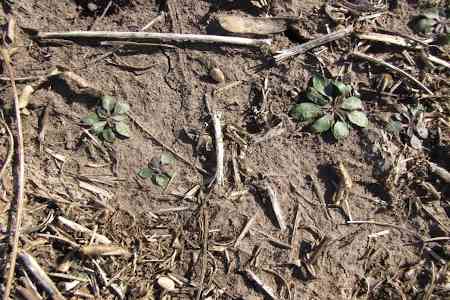
Figure 2. Marestail rosettes in a recently harvested soybean field. Photo from Dallas Peterson.
The use of trade names is for clarity to readers and does not imply endorsement of a particular product, nor does exclusion imply non-approval. Always consult the herbicide label for the most current use requirements.
Source : ksu.edu