Farms.com Home   News

Cotton Marketing News: Acreage Numbers are a Surprise – What Now?

By Don Shurley

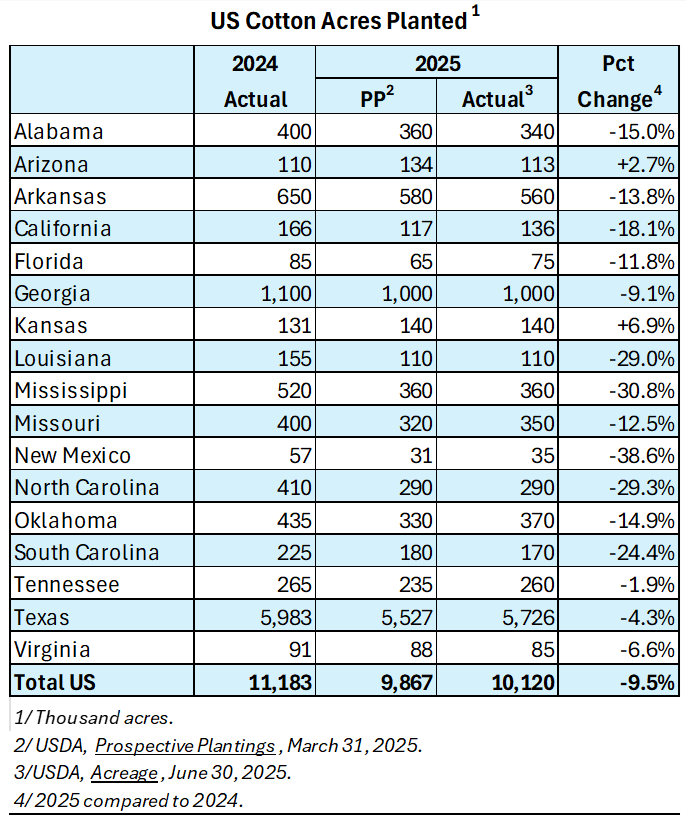
Back in March, farmers said they intended to plant 9.87 million acres of cotton this year.  If realized, that would be an 11.8% reduction from last year.  Prices have not improved since then and expectations were that acres actually planted would be even lower than the March estimate.  So, the contents of the acreage report came as a big surprise to me.

The June 30 Acreage Report was USDA’s first estimate of actual acres planted.  That number was 10.12 million acres 253,000 acres more than the earlier March intentions number.  This is higher than most observers and analysts thought it would be.  Most believed actual acres planted would be less than what farmers back in March said they intended to plant.
Crops

Source : ufl.edu

Trending Video

Dr. Emerson Nafziger: Nitrogen Fertilizer Rates for Corn

Video: Dr. Emerson Nafziger: Nitrogen Fertilizer Rates for Corn

The Crop Science Podcast Show, Dr. Emerson Nafziger from the University of Illinois breaks down decades of nitrogen research. From the evolution of N rate guidelines to how soil health and hybrid genetics influence nitrogen use efficiency, this conversation unpacks the science behind smarter fertilization. Improving how we set nitrogen fertilizer rates for rainfed corn is a key focus. Discover why the MRTN model matters more than ever, and how shifting mindsets and better data can boost yields and environmental outcomes. Tune in now on all major platforms!

"The nitrogen that comes from soil mineralization is the first nitrogen the plant sees, and its role is underestimated."

Meet the guest:

Dr. Emerson Nafziger is Professor Emeritus of Crop Sciences at the University of Illinois at Urbana-Champaign, with degrees in agronomy from Ohio State, Purdue, and Illinois. His research has focused on nitrogen rate strategies and crop productivity. He co-developed the Maximum Return to Nitrogen (MRTN) model, which is widely used across the Midwest. His research spans N response trials, hybrid interactions, crop rotation effects, and yield stability.