Manure application after wheat harvest is occurring and provides an excellent opportunity for taking a sample for analysis. In addition to the nitrogen, phosphorus and potassium content of the manure, testing for micronutrients (zinc, magnesium, manganese) and sulphur, C:N ratio, organic matter content and pH will highlight the full value and give some insight into nutrient availability. Sulphur content can be significant, often providing 20 to 30 lbs of slow-release elemental sulphur. For solid manure, C:N ratio indicates how quickly the organic nitrogen portion of the manure is available. In liquid manure where ammonium nitrogen levels are high, a high pH – greater than 7.8 – can lead to more rapid volatilization. When manure sampling, take sub samples periodically during application, then mix the subsamples into a freezer bag size sample for solid manure or a plastic jar with lid for liquid samples. Keep the sample cool until shipping to an Ontario accredited lab. Liquid manure samples should be agitated, and representative of the manure being applied to the field.
In need of extra forage?
Now is the time to consider planting spring cereals for fall forage if you think you will need more inventory before winter. However, growth rates in the fall are slower so it will likely take more than 45 days to reach boot stage. Therefore, they should be seeded as soon as possible and no later than the first week of September. If they are being used for grazing they should not be pushed beyond mid-September.
Ontario research has shown that the “recipe” is 80 lbs/ac oats + 50 lbs/ac nitrogen. However, a big factor in that recommendation is the economics of seed costs. Given the challenging year and limited supply of oats available, growers may want to consider alternative cereal species for forage production. Forage quality does not vary significantly amongst the different cereal species; however, yields do. Therefore, don’t be afraid to shop around and work out your own cost of production budgets to determine the best forage options for your operation.
Don’t give up on planting winter wheat!
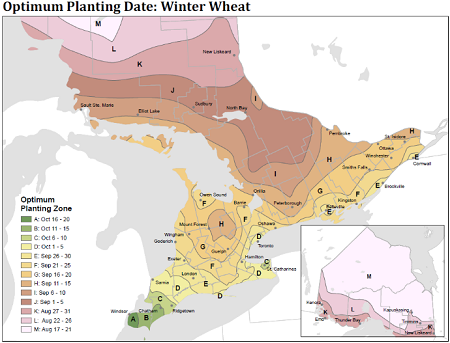
While the optimum planting date for many parts of the province is anywhere from mid to late September (Figure 1), it is unlikely soybeans will be ready for harvest by then. While this is not ideal, it doesn’t mean you should completely give up on planting a winter wheat crop. As we have seen in the past, successful wheat crops can be planted beyond the optimum planting dates for your region if the conditions are right. If the forecast in your region is showing reasonable temperatures that would provide at least 130 Growing Degree Days (GDD) to allow the wheat seed to germinate and emerge before winter, then plant your wheat as soon as you can. This can be done by following the combine in the field as soybeans are harvested. However, to have greater success, make sure the conditions are FIT, all soybean residue is evenly spread, and the drill can easily cut through the residue. Double check that all planting equipment is in good working order well before you get to the field to avoid any further delays.
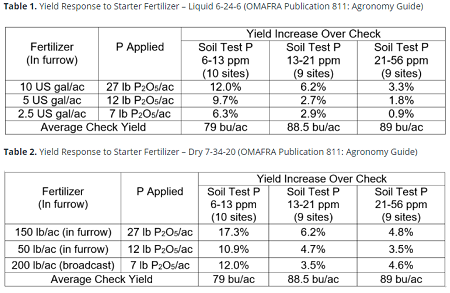
You should also consider using a starter fertilizer. Ontario research has shown repeatedly that winter wheat is highly responsive to a phosphorus-containing starter fertilizer. Starter fertilizer provides nutrients for early growth and promotes root development, ultimately improving winter survival and crop uniformity the following spring. Seed-placed starter fertilizer has shown to increase yields, on average, by 7.5 bushels per acre. Ontario research has also shown that dry granular fertilizers are as effective as liquid 6-24-6 (Table 1 and 2).
Adjusting your seeding depths and populations will also help compensate for delayed planting or less than ideal conditions that may occur at planting. Target to seed your winter wheat at a depth of about 1 inch; any shallower and the crop becomes more vulnerable during the winter months. It is important to remember that it takes 50 Growing Degree Days (GDDs) for wheat to emerge for every inch of seeding depth. So, if you are seeding your wheat deeper than 1 inch, more GDDs are required to get it out of the ground. Seeding rates should also be adjusted if seeding is delayed beyond the optimum timing. Rates should be increased by 200,000 seeds/week to a maximum of 2.2 million seeds/acre. Higher seeding rates when planting is delayed will also assist with the reduced tillering that may occur before winter.
Source : Field Crop