A hay tedder is used to spread and fluff hay in a uniform swath after a windrower, mower-conditioner, rake, or some other type of equipment has created a windrow. Speedy dydown are equivalent to high-quality hay. Hay Tedders allow equal distribution for all different types of conditions, largely thanks to flotation tires that help with smooth operation over irregular land. Tine height adjustments also allow operators to match their implements to crop conditions. If wheel rakes are used to collect hay into windrows, hay tedders exist purely to undo that work. A hay tedder is used to spread the hay out so it can dry more quickly. The hay tedding process allows producers to reduce the dry down time and is especially useful for those that live in wet or humid areas, as it allows them to complete the hay baling process faster.
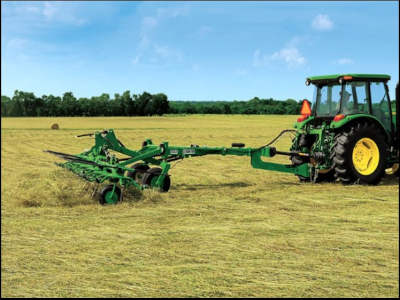
When the hay tedder is in use, it feeds the crop into pairs of spinning rotor teeth. Operators should angle the rotors at an upward angle to lift the crop off the ground and float it to the surface.
So, now that we know a little more about hay tedders and the hay tedding process, what factors should be considered before making a purchase?
Acreage
Selecting the right hay tedder for your operation should start with considering the size of the land being worked on. Customers that have a small area of land to work on might want to consider a TD1010E Hay Tedder, while those working across much larger areas may want to think about a model like the TD3427 Hay Tedder. The size of your operation should dictate the tedder working width that’s needed to get the job done.
Terrain
Depending on the terrain, some hay tedders are a better fit than others. If you’re working on a flat piece of land, a TD1010E can get the job done effectively. However, if the land features irregular ground contours, you may want to consider a model like the TD1316, which has an articulated frame that’s supported by flotation tires to follow the contours with ease. You will also want to consider the transport width of the hay tedder if you will be moving the equipment from field to field.
Click here to see more...