Farms.com Home   News

Farmers Spent $1.4 Billion More on Diesel During Planting Season

By Audrey Jackson

Successful Farming’s Mariah Squire reported that, “a new study by Joint Economic Committee Democrats found that farmers of key crops in the U.S. spent $1.4 billion more on diesel fuel during the 2025–2026 planting season than they did last season.”

“The study, released last Thursday, analyzed corn, soybeans, wheat, cotton, and rice planted by U.S. farmers,” Squire reported. “The 2025–2026 increase in diesel spending to plant those crops was a 63% jump year-over-year, according to the analysis.”

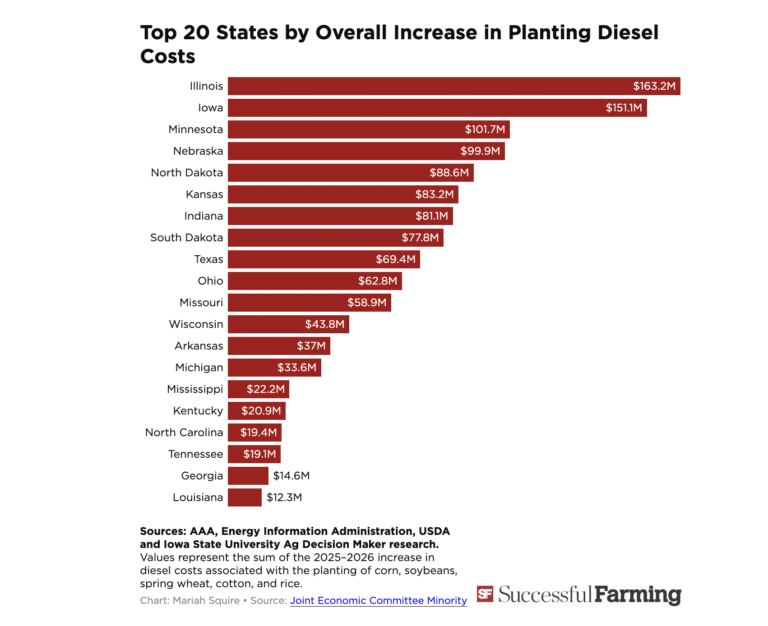
“Calculations were made using data from AAA and the Energy Information Administration, estimates of average fuel use by crop and field operation from USDA and Iowa State University Ag Decision Maker research, and USDA data on 2025 and 2026 acreage and planting windows for the five crop types,” Squire reported.  “The study found that Illinois, Iowa, and Minnesota had the highest increase overall in planting diesel costs.”

“Sixteen of the nation’s top 18 corn-growing states were included in the top 20 states affected,” Squire reported. “All of the nation’s top 18 soybean-growing states were included in the top 20 states affected.”
Crops

Source : illinois.edu

Trending Video

Dr. Fei Yang Discusses Corn Rootworm, European Corn Borer, and Pest Monitoring

Video: Dr. Fei Yang Discusses Corn Rootworm, European Corn Borer, and Pest Monitoring

What insect threats are Minnesota corn growers facing, and what research is helping farmers stay ahead of them?

At the 2026 MN Ag Expo, University of Minnesota entomologist Fei Yang shared updates on three Minnesota Corn-supported research projects focused on insect monitoring, seed treatments, and pest resistance.

Current work includes statewide monitoring programs that use pheromone, light, and sticky traps to track key pests such as black cutworm, true armyworm, corn earworm, European corn borer, and corn rootworm. Researchers are also evaluating whether high-rate seed treatments provide effective corn rootworm control and studying the development of resistance in European corn borer populations to Bt corn traits.

These projects help researchers better understand pest pressures across Minnesota and provide farmers with practical information to support informed management decisions.