Recycling glass, plastic, and metal is something many of us do routinely. Now, a team of Agricultural Research Service (ARS) scientists is looking at recycling something most people probably never even think about: manure.
On farms of the past—and still today in some farming operations—livestock manure was "recycled" as fertilizer for the farm's crops. But that began to change in the 1950s, when separate crop and feeding operations began to replace small, family-run farms. The transition created efficiencies and higher yields, but it also led to chronic manure-management issues. In addition to the sheer volume of manure, the nitrogen and phosphorus buildup poses environmental concerns. Yet nitrogen and phosphorus are key crop nutrients that are now supplied mainly by commercial fertilizers.
"The question is what to do with the manure from livestock operations with surplus manure nutrients, and how to get it to farmland where it is needed most?" said Sheri Spiegal, an ARS rangeland management specialist in Las Cruces, NM.
Spiegal and her colleagues have proposed the concept of "manuresheds" to help get excess manure nutrients to the crops that need them. A play on the word "watersheds," a manureshed is an area of land surrounding animal feeding operations where manure nutrients can be redistributed to meet various goals, including fertilizing crops and building healthy soils.
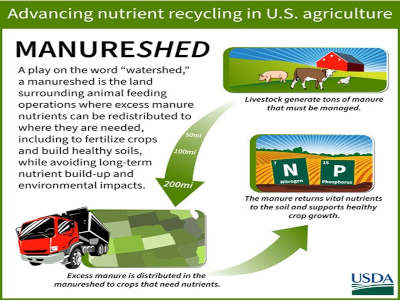
Artist's rendition of a manureshed.
The team outlined how the concept would work in a 2020 paper in the journal Agricultural Systems. They collected data on the manure produced in feeding operations, the fertilizer needed for crops, and the nutrients the crops removed in 3,109 counties across the United States. They then classified the counties as either manure "sources" or "sinks," depending on whether manure nutrients exceeded crop use (sources) or whether crops could use excess nutrients to fill deficiencies or as a substitute for fertilizer (sinks).
Results showed a potential to redistribute manure from source counties to sink counties across much of the country, with source counties in 40 of 48 contiguous states.
The study authors identified clusters of source counties dominated by one or two production systems, such as dairy or poultry, and they highlighted opportunities for redistributing manure in the sink counties surrounding those clusters. This resulted in four regional manuresheds: Carolina Poultry and Hog, Puget Sound Dairy and Poultry, Southern Plains Beef and Dairy, and Interior Highlands Poultry. Possibilities for efficient transport and use of excess manure from each animal industry are also discussed in the paper.
Many hurdles exist for recycling manure nutrients from areas of excess to areas in need—including transport distance and logistics, monetary costs, technology requirements, timing of crop needs vs. manure availability, and social considerations. The manureshed concept is a first step toward identifying the hurdles and their potential solutions. Ultimately, adoption of management based on manuresheds could help producers manage excess manure, increase crop yields, improve soil health, minimize fertilizer costs, and improve air and water quality.—By Sue Kendall, ARS Office of Communications.
Source : usda.gov