By Mitchell Lierman
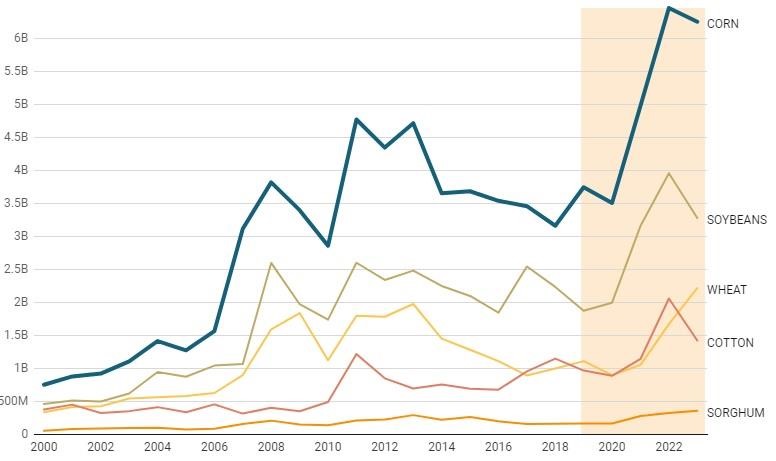
Impacted by drought and export disruptions caused by the war in Ukraine, insurance spending for corn versus that for other crops in 2023 grew to its widest-ever gap.
Increases in annual total corn premiums outpaced other highly-insured crops over the past five years. These policy premiums are paid for, in part, by government subsidies, which on average covered 62% of the crop insurance costs for farmers in 2022, according to the Government Accountability Office.
Deadlines to purchase spring-planted crop insurance were one month after the Russian invasion of Ukraine in February 2022. According to data from the Observatory of Economic Complexity, an open-source project for visualizing world economic data, Ukraine was responsible for 9.3% of global corn exports in 2021.
Corn insurance spending fell in 2023, yet remained near record high
Insurance spending for several crops reached all-time highs in 2022, with earned premiums for corn, soybeans, wheat, cotton and sorghum doubling from pre-pandemic levels. Spending on the three most insured crops last doubled between 2006 and 2008.
Click here to see more...