By Krysta Harden
One year ago today, I was named president and CEO of the U.S. Dairy Export Council.
If I had to choose a single word to describe my first year, it would be “growth.”
I grew as a leader. USDEC grew as an organization. The U.S. dairy industry grew in collaborative unity as we persevered through COVID and an unprecedented export supply-chain crisis creating traffic jams at our ports that kept many of us up at night.
As you may know by now, 2021 also was the most successful year in the history of U.S. dairy exports, with records set for both value and volume.
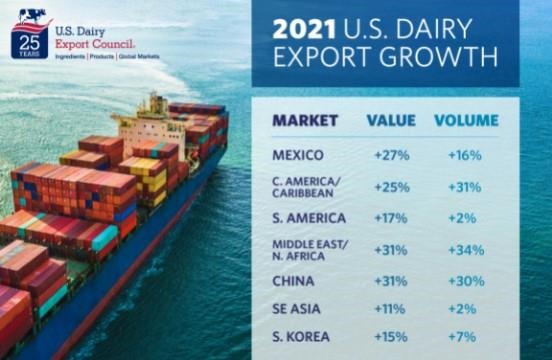
Overall 2021 U.S. dairy exports were up 18% in value and 10% in volume compared to the previous year, setting all-time records while displaying impressive geographic growth across key markets.
After just one year on the job, it would be audacious for me to take the credit. My mother and father -- Georgia peanut farmers who I still respectfully refer to as “Mama and Daddy” -- taught me to give credit where credit is due.
Kudos go to:
- Our USDEC member companies -- building on past successes to find increasingly innovative ways to serve the needs of their global customers.
- Our U.S. dairy farmers -- providing the abundant supply of milk required to create and ship 2.3 million metric tons of milk solids across our borders.
- Our USDEC staff -- working from their homes because our Arlington, Virginia, office has been closed due to COVID. They are the experts on exports, removing barriers and expanding markets for our members.
- Our USDEC international offices in China, Southeast Asia, Mexico, South America, Korea, Vietnam, Japan and the Middle East -- providing on-the-ground insights and ongoing connections when COVID restrictions made international travel difficult.
- The dairy checkoff -- funding most of USDEC’s budget through our parent organization, Dairy Management Inc. In recent years, state and regional checkoff organizations have made additional long-range investments in new people, partnerships and programs, including USDEC’s state-of-the-art U.S. Center for Dairy Excellence in Singapore, serving Southeast Asia.
Numbers tell the 2021 growth story. Year-end export data showed total sales (value) rose 18% over the previous year, to a record $7.75 billion. Export volume was 10% higher, quite an accomplishment when you consider that 2020 also was a record-setting year.
Growth wasn’t just strong. It was strong across products and geographic markets. We saw increases (volume) of 2% in Southeast Asia, 16% in Mexico and 30% in China.
We don’t put our milk into just one market. Diversification has been part of USDEC's strategy to mitigate risks.
When exports to Mexico went down in 2020 due to COVID’s negative impact on the economy, U.S. total exports still went up because growth in Southeast Asia and other markets more than made up for it.
In 2021, when port issues limited U.S. export growth to Southeast Asia, we regained business in Mexico as we increased sales to the Middle East/North Africa, South and Central America, and China.
Today the milk from more than one 1 of 6 tankers leaving American dairy farms ends up in dairy products and ingredients shipped across our borders. Over the last two years, 75% of “new” milk has gone to exports.
Click here to see more...