By Mathews Paret
Situation
Bacterial spot of tomato continues to be the topmost bacterial disease of economic importance in Florida with the potential of causing >20% yield losses under ideal conditions for disease occurrence (Fig.1, Fig. 2). In Florida, the disease is caused by a bacterial species; Xanthomonas perforans. Currently all strains of this bacterium in Florida are copper-tolerant. Integrated use of different types of bactericides (chemical and biological) is thus very critical in minimizing risks associated with the disease in Florida tomato production.
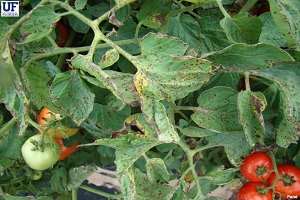
Fig. 1. Severe leaf spot caused by Xanthomonas perforans, the causal agent for bacterial spot on tomato. Photo: Mathews Paret
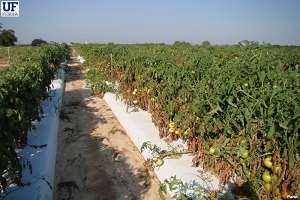
Fig. 2. Severe leaf blight caused by Xanthomonas perforans. Photo: Mathews Paret
NFREC Trials
Key findings from research trials conducted at the North Florida Research and Education Center (NFREC) Quincy, are shown below to highlight the potential for integrated use of bactericides and stand-alone or single-bactericide use. Five Bactericides were compared in the study: Actinovate (Bio-control agent; Streptomyces lydicus), Serenade (Bio-control agent; Bacillus subtilis), Actigard (Plant defense inducer; Acibenzolar S-Methyl), Kocide (Conventional bactericide; copper-hydroxide), and Mankocide/ Kocide + Penncozeb (Conventional bactericide mix with improved bactericidal properties than copper hydroxide by itself; Copper-hydroxide + Ethylene Bis-Dithiocarbamate).
Each chart depicts the Area Under Disease Progress Curve (AUDPC). The higher the AUDPC, the higher the disease severity over the period of the trial. Within the treatment tables the different letters next to the treatments mean that they are statistically different (Pr>F=0.05; LSD)
Spring 2015 Trial
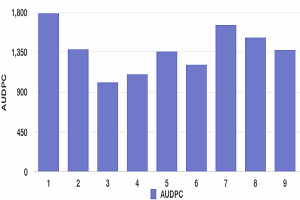
AUDPC: Area Under Disease Progress Curve
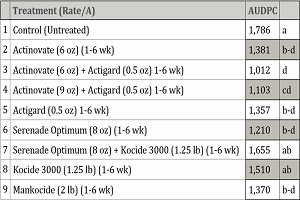
Different letters next to the treatments means that they are statistically different (Pr>F=0.05; LSD)
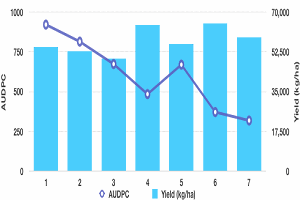
AUDPC: Area Under Disease Progress Curve.
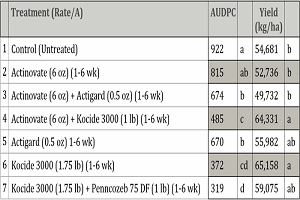
Different letters next to the treatments means that they are statistically different (Pr>F=0.05; LSD)
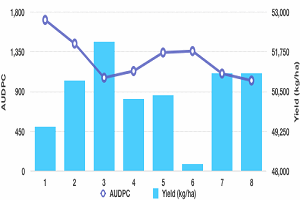
AUDPC: Area Under Disease Progress Curve.
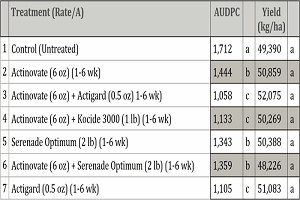
Different letters next to the treatments means that they are statistically different (Pr>F=0.05; LSD)
Summary Points
Use of plant defense inducer and bio-control agents can be effective alternatives to conventional copper bactericides against bacterial spot of tomato.
Integrated use of biological control agents can minimize of risks associated with potential failure of copper bactericides in Florida tomato production.
Source: ufl.edu