By Mike Staton and Martin Chilvers
White mold is beginning to show up in soybeans in Michigan and some producers may want to apply fungicides to reduce the disease severity in their fields. This article will help soybean producers decide when it is too late to apply a fungicide for white mold.
Research has shown that white mold fungicide applications should be made from the R1 growth stage (one open flower on 50% of the plants) through the R3 growth stage (one pod 3/16 inches on the top four fully developed leaf nodes on the main stem). A leaf node is considered fully developed when the leaf attached to the node immediately above it has unrolled leaflets. This application window is the most effective because white mold spores only infect dead flower petals and most of the flowers are produced from R1 through R3. Fungicide applications made after R3 will have reduced benefit. The end of R3 occurs when one of the pods on the upper four fully developed leaf nodes on the main stem is 0.75 inches long.
If fields are exhibiting visible white mold symptoms, it may be too late to apply a fungicide. The fungicides that are rated as good to very good for controlling white mold are effective at preventing infestations on the healthy plants in the field but will not cure or reduce the disease progression on infested plants in the field. If the plants in infested fields have not yet reached the R4 growth stage, a fungicide application may be beneficial if most of the plants in the field are not showing signs of infection and conditions are predicted to favor disease development.
From the road, white mold infestations appear as dead plants at the top of the crop canopy (Photo 1). Upon closer inspection, the disease produces white mycelia growth and black sclerotia (survival structures) on and inside stems and pods (Photo 2).
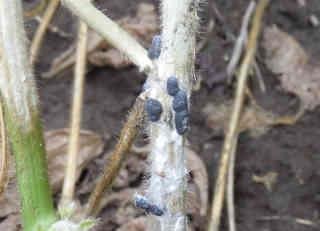
Timely foliar fungicide applications can be useful tools for managing white mold in soybeans, but they are less effective and less profitable when applied after the R3 growth stage. Soybean producers should also consider additional information before applying fungicides to manage white mold in soybeans.
This article was produced by a partnership between Michigan State University Extension and the Michigan Soybean Committee.
Source : msu.edu