By Zhang Nannan
Over the past 100 years, global water use has increased sixfold, and increased drought has led to substantial declines in crop production in recent decades. Soybean [Glycine max (L.) Merr.], originally domesticated in China about 5,000 years ago and subsequently spread worldwide, has become an important and primary source of vegetable oil and protein, as well as a supplement in livestock feed.
However, soybean is one of the most drought-sensitive crops, and drought can significantly reduce its yield and quality. Therefore, breeding high-yielding, drought-tolerant soybeans is critical to meeting the growing demand for soybean production and addressing the worsening water deficit.
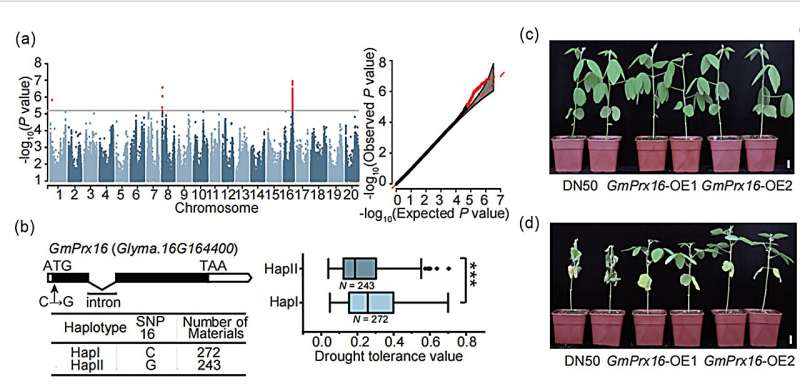
A research team led by Prof. Tian Zhixi of the Institute of Genetics and Developmental Biology (IGDB) of the Chinese Academy of Sciences, in collaboration with Prof. Ma Junkui from the Industrial Crop Institute of Shanxi Agriculture University/Shanxi Academy of Agricultural Sciences, identified the drought tolerance value of 585 soybean accessions covering the major growing areas of the world to mine the genes and corresponding beneficial alleles in soybean germplasm.
The paper entitled "Natural allelic diversities of GmPrx16 confer drought tolerance in soybean" was published in Plant Biotechnology Journal on Nov. 22.
A significant locus on chromosomes 16 was detected by genome-wide association study (GWAS). Further analysis showed that a peroxidase harboring a nonsynonymous SNP was the occasional gene in the locus, and the nonsynonymous mutations resulted in peroxidase activity differences between the two GmPrx16 haplotypes.
Furthermore, overexpression of GmPrx16 in Dongnong No.50 could improve the peroxidase activity and enhance the drought tolerance in soybean, but GmPrx16 RNAi transgenic lines reduced the peroxidase activity and showed a drought-sensitive phenotype.
Click here to see more...