Farms.com Home   News

Rain Chances Finally Improve After a Dry Start to May

By Pam Knox
 
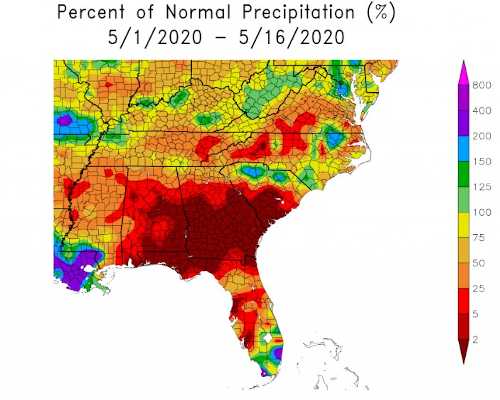
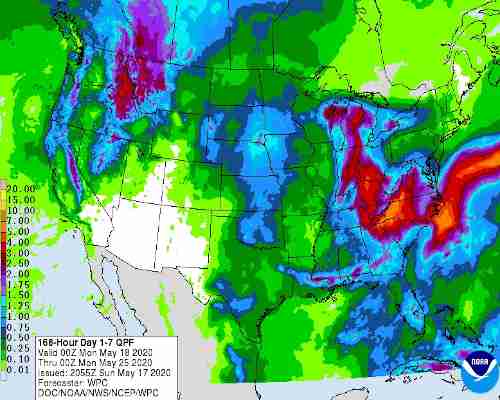
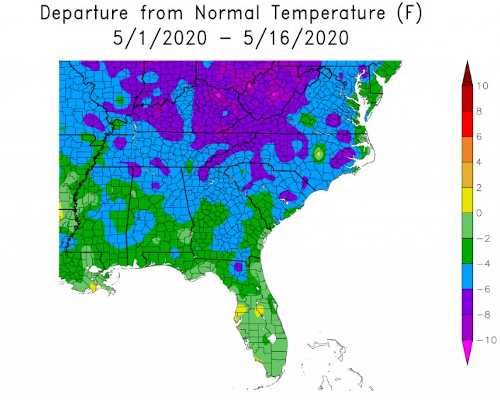
The forecast for rain on Saturday did not look too hopeful for rain in Georgia, but the latest forecast released today looks a lot more favorable for at least an inch of rain this week. We won’t see much if anything from Tropical Storm Arthur, which will be off to our east, but a complex system of fronts and a cut-off low are expected to bring an inch to central Georgia and potentially several inches to the northeast mountains in the next week. The driest period is likely to be next weekend, with showers on and off this week. On Monday there is a slight chance of severe weather, especially in the northeast part of Georgia, but it is not expected to be a big outbreak if anything materializes. Keep an eye out just in case. The rain is sorely needed as we have had almost no rain in the first half of May, although temperatures have been quite cool, and producers have been worried about going into a flash drought. Hopefully the rain this week will give everyone some hope of a return to a wetter pattern.
 

Source : uga.edu

Trending Video

Seeing the Whole Season: How Continuous Crop Modeling Is Changing Breeding

Video: Seeing the Whole Season: How Continuous Crop Modeling Is Changing Breeding

Plant breeding has long been shaped by snapshots. A walk through a plot. A single set of notes. A yield check at the end of the season. But crops do not grow in moments. They change every day.

In this conversation, Gary Nijak of AerialPLOT explains how continuous crop modeling is changing the way breeders see, measure, and select plants by capturing growth, stress, and recovery across the entire season, not just at isolated points in time.

Nijak breaks down why point-in-time observations can miss critical performance signals, how repeated, season-long data collection removes the human bottleneck in breeding, and what becomes possible when every plot is treated as a living data set. He also explores how continuous modeling allows breeding programs to move beyond vague descriptors and toward measurable, repeatable insights that connect directly to on-farm outcomes.

This conversation explores:

• What continuous crop modeling is and how it works

• Why traditional field observations fall short over a full growing season

• How scale and repeated measurement change breeding decisions

• What “digital twins” of plots mean for selection and performance

• Why data, not hardware, is driving the next shift in breeding innovation As data-driven breeding moves from research into real-world programs, this discussion offers a clear look at how seeing the whole season is reshaping value for breeders, seed companies, and farmers, and why this may be only the beginning.