While scouting this week we observed some very small true armyworm caterpillars in South Dakota. Every year these caterpillars pose a threat to wheat fields, and the best way to stay ahead of them is to start scouting before the defoliation is done. True armyworm caterpillars feed on the leaves of wheat, but they also have the potential to clip heads off the plants when the leaves start to dry down closer to harvest. In previous years, large areas within wheat fields have been heavily defoliated by these caterpillars.
True armyworms are migratory pests that start each season in the southern United States. During their northward flight, true armyworm moths are more attracted to fields that contain living ground cover (e.g. grass, weeds, early-season crops). For South Dakota, the moths generally arrive during June and July. Depending on the seasonal migration and their location in South Dakota, one or two generations of true armyworms are possible. The observation of caterpillars already is a little earlier than normal, but we have had a lot of strong south winds this year.
Identification
Caterpillars of the true armyworm can vary greatly in color from light brown to dark green or sometimes almost black (Figure 1). Fortunately, there are some other characteristics that can be used reliably to identify them.
True armyworm caterpillars have an orange stripe on each side of their body that runs from their head to the end of their abdomen. In addition, true armyworm caterpillars will have dark bands on each of their abdominal prolegs (Figure 2).
The last characteristic is the network of black lines that are present on their orange head capsule (Figure 3).
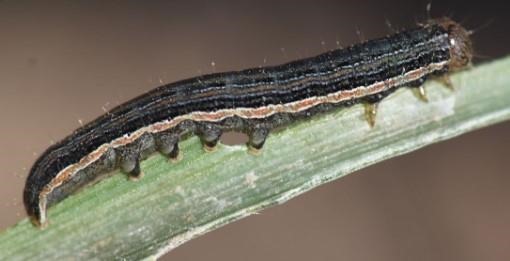
Figure 2. True armyworm caterpillars have an orange stripe on each side of their body and dark bands present on their abdominal prolegs.
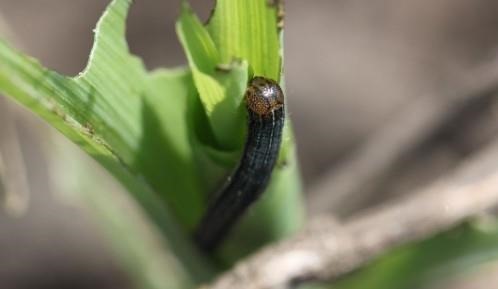
Figure 3. True armyworm caterpillars have a network of black lines present on their orange head capsule.
Scouting and Management
True armyworm caterpillars are generally not present at large enough populations to be noticed. However, they can be easily scouted for with either sweep net sampling or individual plant observations. When scouting, the entire field should be examined. If examining individual plants, the threshold is 2 caterpillars per square yard. Sometimes the caterpillars will be found at the base of the plant or on the soil near the plant. If scouting with a sweep net, the threshold is 40 caterpillars per 30 pendulum sweeps. Remember, when using a sweep net to walk in a “W” or “Z” pattern through the field.
Caterpillar feeding can reduce yields, especially if the flag leaf is removed prior to the soft dough stage. As plants mature, fewer nutrients are available in the leaves, and the caterpillars will move to the heads to either feed on the beards (Figure 4) or cut the stem below the head.
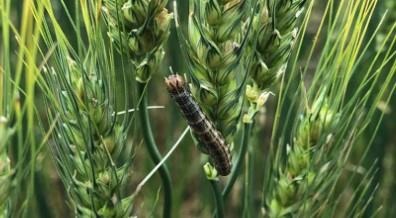
Figure 4. True armyworm feeding on wheat beards.
Source :