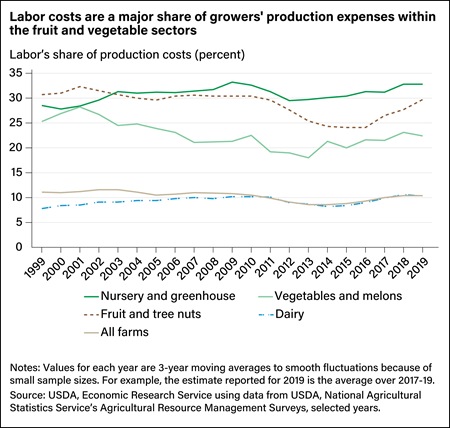
To produce fruits and vegetables in the United States, a human touch is required to sort, pot, and plant seedlings, train young plants and prune older ones, and harvest and pack the crops for shipping. That means hired labor is a critical component of the fruit and vegetable sectors. Labor’s share of the cost of production can run as high as 38 percent for fruit and tree nut farms and 29 percent for vegetables and melons.
Meanwhile, U.S. fruit and vegetable farm operators are having difficulty finding enough workers to fill their needs in a tight labor market, so farm wages are rising at a faster rate than non-farm wages. To address rising labor costs, growers are turning to other production and management strategies to keep their expenses in check. Researchers at USDA’s Economic Research Service, in a recent report, examined how producers are adapting to changing cost structures. They looked at how three adjustments suppliers in these industries are adding to their production and management practices:
- Increasing imports and decreasing domestic production of certain crops if they are not competitive with imports,
- increasing the use of mechanical aids, and
- Bringing in foreign guest workers through the H-2A visa program.
Farm Worker Wages Are Outpacing Growth in Non-Farm Wages
Average hourly earnings of U.S. field and livestock workers, adjusted for inflation, increased 16 percent between 2001 and 2019. In 2022, minimum wages in 29 States were higher than the Federal minimum wage of $7.25. California and Washington, two major employers of hired agricultural labor, had some of the highest minimum wages at $15.00 an hour and $14.49 an hour, respectively. While empirical evidence of widespread farm labor shortages is limited, agricultural wage growth (16 percent) outpacing that of non-agricultural wages (5 percent growth) suggests farm labor markets are becoming tighter.
Click here to see more...