By Bryan Jensen
Checking statewide degree days it looks like the majority of the state should be scouting for western bean cutworm. Pheromone traps have been established at sites throughout Wisconsin to monitor the annual emergence and flight of western bean cutworm moths. The results will be published below and ?updated weekly from? mid-June and continuing through mid-August at this site: https://datcp.wi.gov/Pages/Programs_Services/PestSurvey.aspx
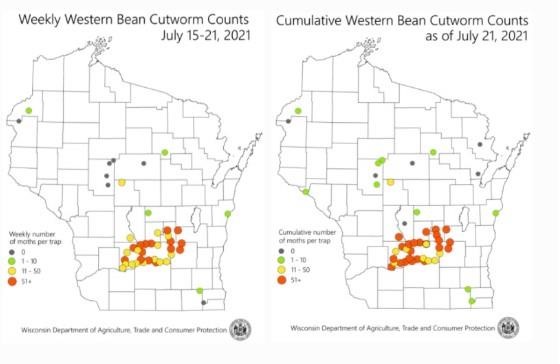
When given a choice, adult females prefer pre-tassel corn to lay eggs because pollen is an important food source for larvae prior to moving to the ear. Infestations are often aggregated within a field so thorough field scout is needed. Go to at least 5 different areas of a field and count egg masses on 20 consecutive plants. Often eggs are found on the upper leaf surface on the uppermost leaves. Use the sun to backlight those leaves and look for the shadow of the egg mass. Later during the adult flight, also look for larvae that may have already hatched. Often, they are found in leaf axils feeding on pollen.
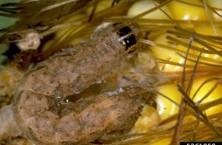
Western Bean Cutworm. Photo credit: Frank Peairs, Colorado State University, Bugwood.org
Please see this card for more information on field scouting. Western bean cutworm is an insect pest which can easily go unnoticed until it is too late.
Source : wisc.edu