By Nevin Lawrence
This past summer, I received a phone call from an agronomist who needed help with Palmer amaranth control. It was mid-July and the Palmer was quickly overtaking the crop. I told him that given the stage of the crop and the height of the Palmer, there really wasn’t much to be done to salvage the field but that I could work with him and the farmer to devise a better strategy for next year. This sort of phone call was familiar. I have been getting more and more just like it each year. But what stood out to me was the agronomist’s response: “I know, I am looking for a cathartic recommendation. It doesn’t need to work; it just needs to make the farmer feel better.”
Glyphosate-resistant Palmer amaranth is the number one issue for sugarbeet growers in parts of Colorado and Nebraska. Group 15 herbicides — Warrant®, Dual Magnum® and Outlook® — are the only effective options in sugarbeet, but in our geography, they can only be applied after the two true leaf growth stage. Depending on the weather conditions in a given year, Palmer can emerge as early as mid-April or as late as mid-June. In sugarbeet, late-emerging Palmer amaranth can be suppressed by the application of repeated and overlapping group 15 herbicides. But when it emerges early, at the same time as the sugarbeets, a single Palmer amaranth plant in one yard of row can lead to between 50% to 90% yield loss (Shultz et al. 2021).
Most growers may be familiar with a weed wiper through use in other crops. Before the advent of Clearfield® varieties, wipers were commonly used to control feral rye in wheat. Since the widespread arrival of glyphosate-resistant Palmer across the country, wipers filled with paraquat have been used in peanut and soybean but can be adapted to other low-growing crops, such as dry bean and sugarbeet.
Paraquat use in a wiper does come with severe drawbacks compared to the use of glyphosate. First is safety. All applicators and mixers of paraquat need to complete a paraquat-specific EPA training program due to the high acute toxicity of paraquat. Second is performance. Paraquat does not translocate. It will only kill the plant parts with which it comes in contact. The University of Georgia’s Pest Management Handbook for peanut lists up to 85% control as possible with a weed wiper, when 60-70% of the of the weed surface is wicked. Getting that 60-70% coverage is only possible if there is a large difference in plant height between the crop and weed, and by the time this height difference is reached, yield loss has likely already occurred.
In 2020, I conducted a trial using a rolling carpet-style wiper, manufactured by GrassWorks, with a 50/50 mixture of Gramoxone® 2.0 and water. There were three study factors, application timing (late July or first week of August), the addition of crop oil, and one vs. two passes. In 2020, none of the treatments differed significantly. When wiping occurred, complete control of Palmer amaranth, kochia and common lambsquarters was achieved (Figure 1); along with a complete prevention of seed production (Figure 2); and while crop injury was observed, the beets largely recovered (Figure 3).
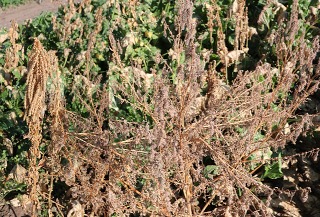
Figure 1. A Palmer, left, and kochia, right, plant a week after paraquat wiping.
Figure 2. Left, seed from a Palmer plant not wicked with Paraquat; right, seed from a head wicked with paraquat; center, germination test of seed from the head pictured to the right. Palmer amaranth seed is identified as black in the photo on the left.
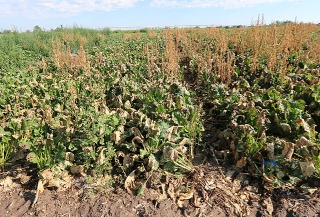
Figure 3. Sugarbeet injury and weed control a week after paraquat wiping.
In 2021 and 2022, weed control was far worse and crop injury far higher. I believe the reason for this lack of success is related to weed density at the time of wiping. For moderate infestations, the wiping resulted in good coverage with limited off-weed dripping. In 2021 and 2022, weed density in the test plots was so severe that paraquat coverage was poor and increased contact between treated Palmer amaranth and sugarbeet caused crop injury.
And this speaks to a bigger issue with researching this topic. A lot of the efficacy of wiping on paraquat is function of experience rather than science. You need to have the right speed, wiper height and wiper saturation. Wiper saturation is an especially delicate adjustment to make. Control is best if the paraquat is running down the stem of the weed to the base of the plant. But over-saturating the wick leads to dripping and increased crop injury. Finding that right balance takes experience, and with several different manufactures of many different styles of wipers, the equipment setup in a research plot may not carryover to what a grower may choose to do.
So, is wiping of paraquat a solution to herbicide-resistant weeds in sugarbeet? No, but under the right conditions it can limit seed production, preserve yield and make harvest easier late in the season when other options fail. Under less-than-ideal conditions, the best it might offer is cathartic weed control.
Source : unl.edu