Only eight percent of farms were operated entirely by women
On May 2, 2024, the United Nations General Assembly adopted a resolution declaring 2026 as the International Year of the Women Farmer (IYWF), with 123 countries co-sponsoring the initiative. The resolution, introduced by the United States, signals a global commitment to empowering women in agriculture and recognizing their contributions across agrifood systems.
The goal of IYWF is clear: spotlight the essential roles women play in food production, trade, and sustainability—roles that often go unnoticed. Women farmers are central to food security, nutrition, and economic resilience. While much of the focus will be on developing countries, the U.S. has its own gender gaps to address.
Current Statistics
In 2022, there were 1.2 million female producers in the United States, representing 36 percent of the country’s 3.4 million producers—the most recent statistics available. Compared to their male counterparts, female producers were slightly younger, more likely to be beginning farmers, and more likely to live on the farms they operate.
These statistics are from the USDA’s National Agricultural Statistics Service, the 2022 Census of Agriculture, 1.2 million female producers is a slight decrease of 0.2 percent from 2017. The number of farms with a female producer also declined by 3 percent compared to the previous census.
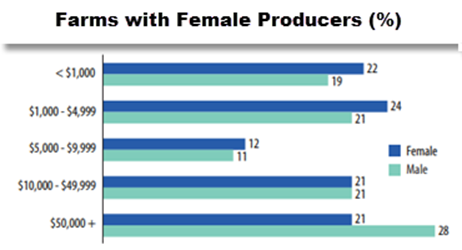
Caption: Farms with Female Producers and Farms with Male Producers, by Economic Class, 2022 (sales and government payments combined). Photo Credit: USDA NASS
Overall, 58 percent of U.S. farms, or about 1.1 million, had one or more female producers involved in decision-making, while 92 percent had at least one male producer. States in the Northeast, Southwest, and West reported higher shares of female producers.
Texas had the largest number of female producers overall, but Arizona and Alaska led in proportion, with women representing 48 percent of all producers in those states. Other states with high shares included New Hampshire (45 percent), Oregon (44 percent), and Maine, Hawaii, Rhode Island, Massachusetts, and Nevada, each at 43 percent.
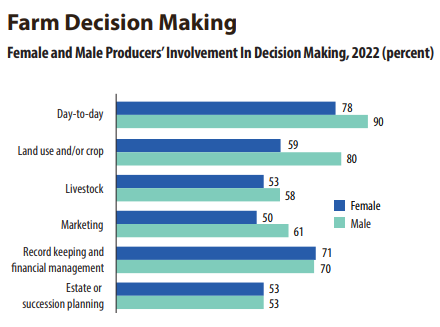
Photo Credit: USDA NASS
Female producers were most involved in day-to-day record keeping and financial management decisions, while male producers were more likely to make decisions about land use, crop and livestock production, and marketing. Only eight percent of farms were operated entirely by women, and most female producers worked on farms with more than one producer.
Of the 1.2 million female producers, just 11 percent operated farms where they were the sole decision-maker, compared to 37 percent of male producers who ran farms alone. On average, female producers were slightly younger than their male counterparts—57.8 years versus 58.3—and more likely to be beginning farmers, with 33 percent having farmed for 10 years or less compared to 28 percent of men. Women were also more likely to live on the farms they operated and less likely to report farming as their primary occupation.
To help address some of the under-representation in agriculture, the National Association of State Departments of Agriculture has undertaken the national Women in Agriculture Study “to explore women’s leadership and involvement across the industry, identify barriers and opportunities, and provide actionable insights to strengthen engagement and support systems.
This study offers a unique opportunity to highlight the significant role women play in driving innovation, leadership, and engagement in agriculture both today and for generations to come.”
Click here to take the survey.
Headline Photo Credit: FAO