Farms.com Home   Ag Industry News

Salford introduces high capacity-self-steering commodity cart with section control

Cart can carry up to 10 tons of two different products

By Diego Flammini
Assistant Editor, North American Content
Farms.com

Salford has introduced a new piece of machinery designed to help farmers spend less time in the field, but accomplishing more.

The PathFinder ST-10 self-steering commodity cart is capable of carrying up to 10 tons of two different products and controlling four different application sections.

It comes equipped with 120 and 180 cu ft. capacity tanks and uses Salford’s Valmar metering technology.
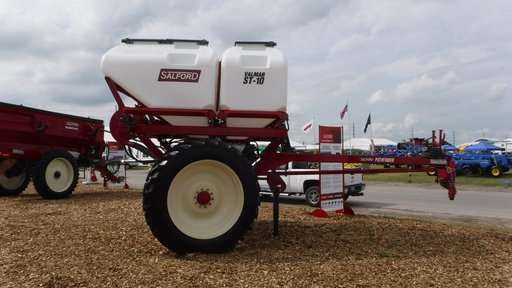
“Both metering systems deliver product to a single funnel that drops in to a common venturi air stream for the highest possible blending accuracy and efficienty,” Salford said on its website. “There is no need to run two sets of air lines to the application knife as all the blending happens right at the metering system.”

Dennis Rice, lead engineer at Valmar, said the metering system is designed to work with seed so it doesn’t crush fertilizer.

Jack Huerkamp, a farmer from Macon, Mississippi currently uses the PathFinder on his 1,800 acres of corn and cotton.

He said it made his days in the field a little bit easier.

“With the PathFinder we were able to speed up and increase our fertilizer output compared to our previous cart,” he said in a release. “We’d stop every now and again to get out a little chunk of fertilizer that might stop the rollers, but otherwise I could run our 12 rows with up to 600 pounds per acre at about 6 miles per hour.”


Trending Video

How farmers are protecting the soil and our food security | DW Documentary

Video: How farmers are protecting the soil and our food security | DW Documentary

For a long time, soil was all but ignored. But for years, the valuable humus layer has been thinning. Farmers in Brandenburg are clearly feeling the effects of this on their sandy fields. Many are now taking steps to prepare their farms for the future.

Years of drought, record rainfall and failed harvests: we are becoming increasingly aware of how sensitively our environment reacts to extreme weather conditions. Farmers' livelihoods are at stake. So is the ability of consumers to afford food.

For a few years now, agriculture that focuses solely on maximum yields has been regarded with increasing skepticism. It is becoming more and more clear just how dependent we are on healthy soils.

Brandenburg is the federal state with the worst soil quality in Germany. The already thin, fertile humus layer has been shrinking for decades. Researchers and farmers who are keen to experiment are combating these developments and looking for solutions. Priority is being given to building up the humus layer, which consists of microorganisms and fungi, as well as springtails, small worms and centipedes.

For Lena and Philipp Adler, two young vegetable farmers, the tiny soil creatures are invaluable helpers. On their three-hectare organic farm, they rely on simple, mechanical weed control, fallow areas where the soil can recover, and diversity. Conventional farmer Mark Dümichen also does everything he can to protect soil life on his land. For years, he has not tilled the soil after the harvest and sows directly into the field. His yields have stabilized since he began to work this way.

Isabella Krause from Regionalwert AG Berlin-Brandenburg is convinced after the experiences of the last hot summers that new crops will thrive on Brandenburg's fields in the long term. She has founded a network of farmers who are promoting the cultivation of chickpeas with support from the scientific community.