Canadian farmers are reaching out to a girl with questions
By Diego Flammini
Staff Writer
Farms.com
If a girl wants to be part of the ag community, she can be.
That’s the message several Canadian farmers are helping share with a young girl in the Ottawa, Ont. area.
Adrian Harewood, a news anchor with CBC Ottawa, posted a message on Twitter on Friday following story time with his five-year-old daughter, Zoe.
The pair had presumably finished reading an ag-related book.
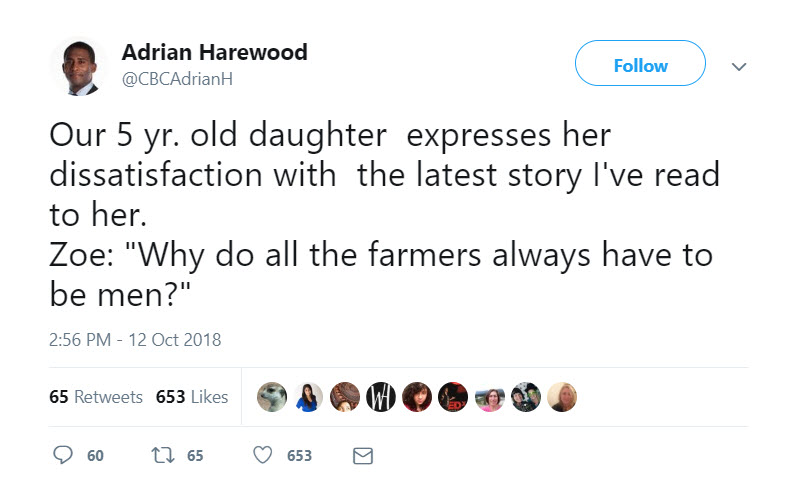
“Why do all the farmers always have to be men?” Zoe asked, her father’s tweet said.
That’s when female farmers began reaching out to Zoe through her father on social media to show how many women work in agriculture.
Sandi Brock, a sheep producer from near Staffa, Ont. and director with Ontario Sheep Farmers, put a video message on Twitter for the girl.
“Well, Zoe, I’d like to introduce you to a few people,” she said in the message.
The post is accompanied by a slide show of several Canadian women working in ag showing their names and job descriptions.
Eliminating the assumption that only one gender can work in a specific industry is important for everyone, said Amanda Hammell, a dairy farmer from Bruce County who also works in ag lending.
“A majority of kindergarten teachers are female, and a majority of nurses are female, but that doesn’t mean there aren’t men working in those industries,” she told Farms.com. “It’s the same in agriculture. Women have always been involved in the industry. I grew up with my mom working on the farm beside my dad, and I’m an equal partner with my husband on our farm.
“Working in ag lending, I have conversations with farm operators and I can tell you that I speak with several women who are fully involved on their farms.
“I’ve never felt that I couldn’t do anything because I’m a woman. It’s important we show young girls that they can do anything they want. It’s also important that young boys understand that as well.”
Rebecca Coates, executive director of the Ontario Ginseng Growers Association, echoed Hammell’s thoughts.
“I came from a manufacturing background and was always surrounded by men,” she told Farms.com. “But that didn’t mean I couldn’t do the work just as well as they did.”
Since Harewood posted his original message, several women in the industry have come forward to offer support, resources and, in some cases, invitations for Zoe to visit their farms. Even some American producers have sent messages.
Showing Zoe that agriculture is a supportive community can help her gain confidence if it’s an industry she wishes to pursue, said Kim Sytsma, a beef producer from near Brockville, Ont.
“Zoe can do anything she puts her mind to,” she told Farms.com. “It will be great for her to know that, if she has any questions about farming, there are so many people that look like her that she can ask.”