Ranches in British Columbia are putting the technology to use
By Diego Flammini
Assistant Editor, North American Content
Farms.com
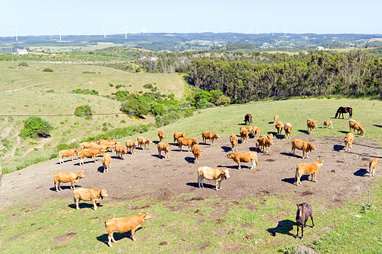
Some ranches throughout British Columbia are using drone technology to keep track of cattle.
John Church, cattle research chair at Thompson Rivers University in Kamloops, told The Homestretch the idea came after he saw kids playing with a drone.
"It was about two-and-a-half years ago I saw some kids playing with a toy drone and I realized they had a camera on that drone and I thought to myself, 'we could use this to observe cattle in pastures,'" he said.
Using a drone to track cattle along pastures boils down to two things: saving time and saving money.
Getty
“Many will actually hire a helicopter, but those are very expensive. They’re $1,000 to $1,500 (per hour) and the ranchers can only afford to hire them to come once for about four hours,” he said.
“It takes a two- to three-hour job and turns it into a two-minute job,” Clay Harsany, a second-year Thompson Rivers University student, told CBC.
Harsany said he and others discussed flying a drone over each individual pen, taking photos and relaying the information back to a computer to count the cattle more efficiently.
Recently, he was asked to find nine missing cattle, and using a drone allowed him to do it quickly.
“Within an hour, I’d found five or six of them,” he told CBC.