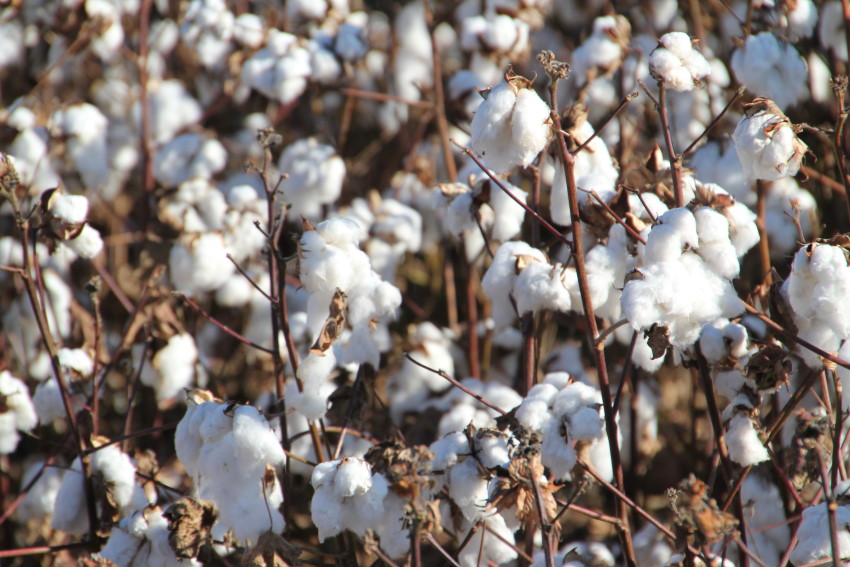
 The 2015 Oklahoma cotton crop turned out to be an excellent crop- both in terms of the quantity produced and the quality that has been ginned. In the latest Cotton Comments published electronically by the OSU Southwest Research and Extension Center in Altus, the top story provides an overview of this past season's cotton crop in Oklahoma.
"According to the most recent USDA-NASS 2015 crop report, 215,000 acres were planted with 205,000 acres expected to be harvested. Due to record May rainfall in many areas, substantial soil moisture was prevalent in many counties. A dry spell in August and September was the main limiting factor impacting the crop.
"USDA-NASS projects Oklahoma cotton production to total 370,000 thousand bales, 37 percent higher production than 2014. Yield is expected to average 866 pounds per acre, compared with 615 pounds last year. If this projection is met, the 2015 crop would be the second largest since 2000.
"The USDA-AMS Classing Office at Abilene is reporting that color and leaf grades, staple, micronaire, strength, uniformity, and bark contamination have all been good to excellent for many producers. This is based on classing results for about 340,000 bales of Oklahoma ginned cotton classed through February 26. A total of 51% have been color grades 11, 21 or 31, with 26% with color grade 11 or 21 – the best possible. Leaf grades have averaged 3.1 with 27% exhibiting leaf grade 1 or 2 – the best quality possible. Bark contamination is present in about 13% of the bales classed thus far.
"Staple (fiber length expressed in 32nds inch) has averaged 36.0. This is good considering the moisture stress encountered in some areas in August and September. A total of 43% of the crop has a 37 or longer staple, with an additional 25% classed as a 36. Micronaire (a measure of maturity) averaged 4.2 units, with 92% in the range of 3.5-4.9. Currently the strength average is 31.3 g/tex, with 88% classed as 30 g/tex or higher.
Click here to see more...