Farms.com Home  › News

Bean Leaf Beetles in Soybean: Biology and Early Season Management

By Robert Koch and Bruce Potter 

We are finding bean leaf beetles colonizing fields and feeding on soybean leaves. Bean leaf beetles had been uncommon in Minnesota soybean since the mid-2000s. However, over the last couple years, we’ve seen an increase in the abundance of this insect in western Minnesota, with some fields reaching economically significant infestations. While beetles are present in 2022, it is still unclear what impact winter might have had on bean leaf beetle populations. Here we provide an overview of the biology, scouting and management of this pest.
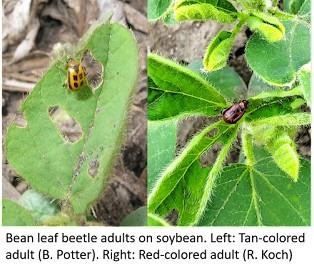
Bean leaf beetle adults on soybean

 Bean leaf beetles are about ¼-inch long and may be yellow, tan, orange or red in color. The beetle’s backs usually have black-rimmed elytra (hardened front wings) with four rectangular black spots, and a black triangle at the base of the wings. The number of spots can vary, but the black triangle at the base of the wings is always present.


Bean leaf beetles spend the winter under leaf litter in wooded areas or field margins. As spring temperatures warm into the 50s Fahrenheit, the overwintered beetles become active, mate, and feed on alfalfa and clovers, moving to soybean seedlings as the plants emerge. Bean leaf beetle feeding injury to soybean leaves is distinctive, consisting of small rounded holes. The eggs are laid in the soil near soybeans plants, hatching into small white larvae. The larvae are similar to corn rootworm larvae and feed on soybean roots and nodules of the plants, but this feeding by larvae is assumed to have minimal if any impact on yield. The larvae will eventually pupate in the soil and the next generation of adults will emerge to feed on the leaves and pods of these plants. Feeding on the surface of soybean pods can injure seeds and allow the entry of bacterial and fungal pathogens. In Minnesota, there is typically only one generation of bean leaf beetles per year. However, with warm temperatures and early planting, two generations are possible in southern Minnesota.


For soybean, the earliest planted fields are often most attractive to this pest. Neonicotinoid seed treatments usually provide good control of early season infestations of bean leaf beetle. Soybean plants are very tolerant to defoliation from adult bean leaf beetles, meaning plants can sustain considerable levels of loss of leaf area without impacting soybean yield. Treatment decisions for bean leaf beetles on early vegetative stage soybean can be based on a threshold of 30% defoliation (with the pest still present in the field). Thresholds based on counts of bean leaf beetle are also available, but the mobility and skittish nature of these beetles can make it difficult to get accurate counts. Bean leaf beetle can also vector bean pod mottle virus (BPMV). More information on BPMV can be found in the factsheet, Bean Pod Mottle Virus on Soybean. This disease is particularly important in seed production fields where bean leaf beetle may require more aggressive management.

Scouting for bean leaf beetle should continue through the growing season, because of feeding from the subsequent generation/s. Particular attention should be paid to early infested fields because populations may build over the season in those fields resulting in significant defoliation and pod feeding. In later growth stages of soybean, decisions to apply foliar insecticides can be based on levels of defoliation. The recommended thresholds for defoliation consider the combined feeding from bean leaf beetles and other defoliating insects such as caterpillars, grasshoppers, etc. For soybean prior to flowering a conservative threshold for treatment is 30% defoliation (with the pests still present in the field). For soybean at or after flowering this threshold decreases to 20% defoliation. Estimates of defoliation should include plants from multiple locations in the field and leaves from the top, middle and bottom of each plant to provide an overall estimate of canopy-level defoliation. Estimating defoliation can be deceptive with many people tending to overestimate the percent of leaf area removed. To calibrate your eye for estimating defoliation, tools like Disease Severity and Insect Defoliation Training can be used. If bean leaf beetle are feeding on pods, consider treating if pod injury reaches 10%. If the beetle begin clipping pods from the plants, the infestation should be treated more aggressively.

Source : umn.edu

Trending Video

Can Gene Editing Give Seeds a Stronger Start?

Video: Can Gene Editing Give Seeds a Stronger Start?


Reagan Reed has a way of describing his research that might make a plant breeder pause.

“I’m the sort of person who likes to break things to understand them,” he says.

What he breaks are genes involved in seed germination. Reed, a Ph.D. candidate at the University of California, Davis, is investigating whether changing those genes can help seeds establish healthy plants under a wider range of conditions.

Reed recently attended the National Association for Plant Breeding meeting in College Station, Texas, as an NAPB Borlaug Scholar. His work speaks to a question that matters well beyond a research lab: what does it take for a seed to get a crop off to a strong start?

A seed that germinates quickly, alongside the others planted with it, spends less time vulnerable to stresses before seedlings become established.

“If you’re able to bridge that gap between germination to stand establishment, then that’s going to give you the highest probability of having a solid yield that year,” Reed says. “There’s a bunch that can go wrong after that, but it maximises your yield from the start, at least.”

Reed works in Dr. Imtiyaz Khanday’s lab at UC Davis, where his research focuses on seed quality in tomatoes and potatoes. He brings an unusual academic background to the work: at Skidmore College, he studied both biology and Latin.

Reed believes that combination prepared him for research. Translating an ancient text means studying each word, weighing its possible meanings and using context to reach the best interpretation. There is rarely a way to know with complete certainty what an author intended. Science, he says, requires a similar willingness to work through uncertainty.

“Attention to detail and comfortability working with uncertainty,” is how he sums up what Latin taught him.

In the lab, uncertainty can produce a surprise. Reed describes changing one gene and seeing little effect. Changing a second gene also appears to do little. Put both changes in the same genetic background, though, and the result can be substantial.

“I break this gene, nothing really happens. I break this other gene, nothing really happens. I combine them into the same genetic background, and now there’s a massive effect,” he says.

Those interactions matter as researchers gain the ability to edit multiple genes at once. They also complicate any simple account of how a trait works: improving a seed may depend on understanding what several genes do together.

For Reed, the question is whether that knowledge could help seeds germinate reliably when conditions are difficult. Some of the genes he studies prevent germination under certain conditions. That response may serve a plant well in one setting while limiting its usefulness in agriculture. He wants to learn what happens when those genes are changed, and whether the result improves establishment.

Yet a discovery that works in a lab still has a long way to travel before it reaches a field. Reed argues that agricultural biotechnology faces an economic challenge as well as a scientific one. New tools can create value for farmers, he says, but developing them requires a way to support the work in an industry where margins can be thin.

His fellowship with Flagship Pioneering gave him a view across AI, agriculture-related work and human health research. It also reinforced the importance of bringing people with different expertise into the same conversation—a benefit of gatherings such as the NAPB meeting.

“You need to have a team of people with different backgrounds who are willing to work together and approach the same problem in different perspectives and different ways,” he says.

That thinking connects the different parts of Reed’s path. Latin taught him to examine details without expecting a perfect answer. Gene editing lets him test what individual genes do—and what happens when their effects combine. Working with people beyond his own field helps him ask what those findings could become.

He came to agriculture because of its reach: the possibility that work by a small group of researchers could eventually make a difference on a much larger scale. His immediate focus is smaller and more precise. He wants to understand what helps a seed get through its first days and become a healthy plant.