.jpg)
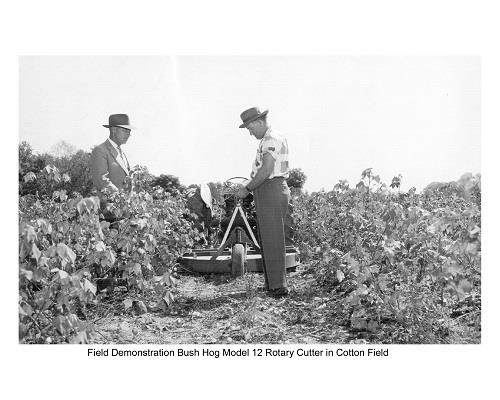
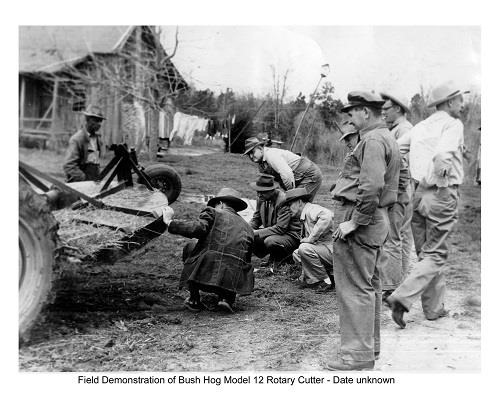
In 1951, a new device designed to clear pasture and crop residue was being demonstrated to a group of farmers near Selma, Alabama. Witnessing the ease at which the tractor-pulled implement devoured heavy brush, an elderly gentleman wearing worn overalls stepped forward and observed, “That thing eats bushes like a hog!” And the name was born. Bush Hog has been located in Selma since its inception and is celebrating its 70th anniversary in October 2021
Today, the company employs approximately 350 people at its Selma, Alabama headquarters with 30 territory managers throughout the United States and Canada. Not only is Bush Hog a well-recognized brand in North America, but their machines have been shipped around the world to countries including, United Kingdom, Australia, New Zealand, South Africa, Brazil, China, Japan, Norway, Denmark, Sweden, India, Vietnam, France, Portugal, Switzerland, New Guinea, UAE, most major Caribbean Islands and every country in Latin America.
Bush Hog products are built-to-last and field-tested—literally! In the early years, the Research and Development department consisted of an employee taking equipment to the family farm and trying their best to tear it up. This process was used to identify weak spots and areas that needed improvement or reinforcement. They would bring the equipment back to the shop, engineers would fix it up, and then back to the farm to try and bust it up some more. If Bush Hog couldn’t bust it, it was ready for production! And while today’s product and safety training is much more sophisticated, it’s that kind of heritage that has led to a reputation for reliability and performance customers can count on. In fact, many Bush Hog products in use today are more than 50 years old!
Bush Hog’s vision is simple… to bring superior value to our customers, employees and stakeholders. Our mission is to provide products and support that help our customers turn their property into a land of opportunity, so they can live their version of the American Dream.
The company’s values go beyond bending steel and selling to customers. Bush Hog focuses on giving back – both in the local community and in many other areas across North America. For eight years they have conducted a fund-raiser for breast cancer awareness in partnership with the Joy To Life Foundation, an Alabama based organization providing mammograms and other breast cancer screenings to medically underserved women and men. Bush Hog donates a pink zero turn mower and all donations received go to support Joy To Life’s mission. Bush Hog has also worked with organizations such as AMVETS, St. Jude Children’s Research Hospital, Shriner’s Hospital for Children, Girl Scouts, Boy Scouts, Project Clean Up Selma, Dallas County, City of Selma, the local Food Bank, Edmundite Missions, Camp Grist State Park, Alabama Teen Challenge, SABRA Sanctuary and even a ministry in Zimbabwe among others.
Bush Hog also invests in the future of the local community. They have developed a relationship with local schools to help with the learning process. Employees donate time to tutor students in city schools which resulted in accelerated reading levels for the kindergarten thru 5th grade students participating in the program. The tutoring was initially done personally in the classroom, but has continued virtually for the past 2 years. Bush Hog engineers have also worked closely with robotics teams for county schools as they learn skills and compete with their classroom built robots.
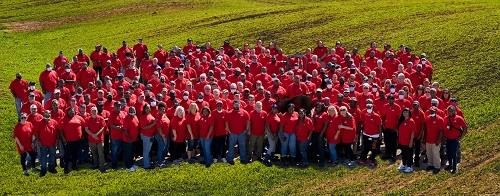
Bush Hog has been celebrating its 70th anniversary throughout 2021. Recently the family of employees came together for an afternoon company-wide celebration. Employees sat together for a catered meal, danced to music, played games, won door prizes and enjoyed fellowship with their Bush Hog teammates. No one left empty-handed as every employee received a 70th anniversary logo gift bag, t-shirt, cap, cooler, keychain, and bag of cookies. Bush Hog President, Jerry Worthington, commended the success of the company and the employees. “Bush Hog is such a wonderful company, and our folks are the key factor in this success and longevity. I am proud to work with this Bush Hog family and celebrate the things we continue to accomplish together. We are proud as a team of the past 70 years and excited about the next 70!”
From the beginning in 1951 thru today, Bush Hog products are still built tough in Selma, Alabama. And as one customer said…”If it doesn’t say Bush Hog, it just won’t cut it!"
Source : Bush Hog