By Mary Hightower
The cattle industry seems to be shrugging off some of the disruptions brought by the COVID-19 pandemic with cattle placements and marketings on an upward swing as the industry approaches its seasonal peak, according to October’s Cattle on Feed report from the U.S. Department of Agriculture.
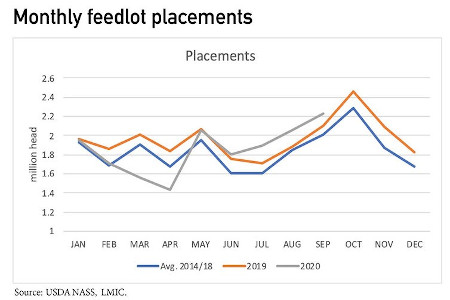
The cattle industry seems to be shrugging off some of the disruptions brought by the COVID-19 pandemic with cattle placements and marketings on an upward swing as the industry approaches its seasonal peak.
Feedlot placements typically peak in October. October placements will be described in the November Cattle on Feed report.
September’s feedlot placements totaled 2.23 million head, 6 percent above the year-ago placements.
“September marks the fourth consecutive month of feedlot placements above year-ago levels,” James Mitchell, assistant professor and agricultural economist for the University of Arkansas System Division of Agriculture, said. However, since the beginning of 2020, “total placements through September were 3 percent below 2019 levels for the same period.”
Feedlot placements were 11.72 million head as of Oct. 1, which was 4 percent above a year ago. Mitchell said that October marked the third consecutive month of “on feed” inventories above year-ago levels.
September marketings of cattle were 6 percent above a year ago, although Mitchell noted that September 2020 had one more business day than September 2019.
One other factor weighing on the industry is drought in the southern plains.
“The drought will likely play a role in determining the destination of calves sold this fall, specifically, the number of lightweight feeders placed in feedlots this fall relative to those going to a winter backgrounding or grazing program,” Mitchell said.
He said if weather undermines growth of winter grazing, “we might see impacts on stocker cattle demand, which places downward pressure on regional feeder calf prices.
“If there is not adequate wheat pasture, calves would potentially be placed directly in a feedlot or an alternate backgrounding program,” Mitchell said.
On a brighter note, “we are expected to see some much-needed moisture this week in the southern plains, and I encourage producers to continue to monitor price-weight relationships in market reports as an indicator for winter grazing prospects,” he said.
Mitchell said that “as of Oct.19, 35 percent of pasture was in poor or very poor condition in the southern plains.”
Mitchell’s analysis is part of an ongoing project describing the continued impacts of the COVID-19 pandemic on the nation’s economy. His analysis may be found at https://bit.ly/3ouTpOA.
Source : uaex.edu