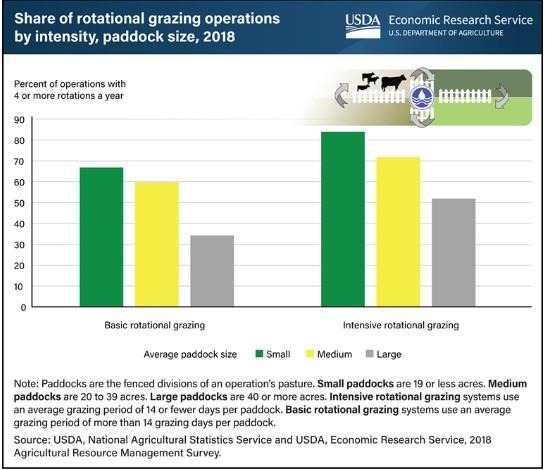
Researchers at USDA, Economic Research Service (ERS) examined rotational grazing systems on beef cow-calf operations and found that as average paddock size increased, farmers and ranchers tended to rotate their cattle less frequently. Rotational grazing systems are those in which livestock owners rotate animals among a series of paddocks (fenced pasture areas), allowing forage to recover before returning the cattle to graze in that spot again. A key decision for ranchers and farmers that affects forage growth is the number of rotations for a given number of paddocks. A large portion (84 percent) of intensive rotational grazing (IRG) operations with small paddocks (paddocks of 19 acres or less) rotated their cattle so that each paddock had four or more rotations per year. Intensive rotational grazing systems use an average grazing period of 14 or fewer days per paddock. In contrast, researchers found that about 52 percent of IRG operations using large paddocks (40 acres or more) rotated cattle four or more times per year. This pattern of smaller paddocks and more rotations was even more evident for basic rotational grazing (BRG) operations, which use an average grazing period longer than 14 days per paddock. Around 67 percent of BRG operations with small paddocks used four or more rotations per paddock per year, but the share drops to 35 percent for BRG operations with large paddocks. The relationships between rotation frequency, paddock size, and system intensity highlight the complexity underlying the practice of rotating cattle through multiple paddocks. This chart appears in the ERS report Rotational Grazing Adoption by Cow-Calf Operations, published in November 2022.
Source : usda.gov