By Dustin Vande Hoef
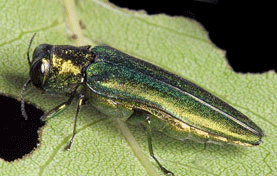
Emerald ash borer has been positively identified in Brighton and Birmingham, bringing the total number of confirmed counties to 34 since it was first detected in Iowa back in 2010. EAB is responsible for the death of tens of millions of ash trees in the 27 states it has been detected. It is a native insect of Asia and was first reported in the U.S. in Michigan in 2002.
The Brighton discovery in Washington County came after a concerned homeowner alerted the Iowa EAB Team about an ash tree showing signs and symptoms related to EAB. For Birmingham in Van Buren County, the tree was noticed in a public area. In both cases insect specimens were collected and sent to the USDA Systematic Entomology Laboratory in Maryland where they were confirmed as EAB.
“We are not surprised to find more infestations in the southeast part of the state,” said Mike Kintner, Iowa Department of Agriculture and Land Stewardship EAB and gypsy moth coordinator. “This area of the state has been hit the hardest with number of detections. Burlington was the first southeast Iowa finding back in July 2013.”
The adult beetle is metallic green and only about one-half inch long and slender, making it difficult to recognize in the landscape. The larvae stage of this wood-boring insect tunnel under the bark of ash trees, disrupting the flow of water and nutrients, ultimately causing the tree to die. EAB infested ash trees include canopy dieback beginning at the top of the tree and progressing downwards, S-shaped feeding galleries under dead or splitting bark, D-shaped exit holes, water sprouts (along the trunk and main branches) and increased woodpecker activity to the bark.
The Iowa EAB Team urges Iowans to use locally sourced firewood, burning it in the same county where it was purchased. Firewood is a vehicle for the movement EAB and other tree-killing pests.
At this calendar date, the treatment window for soil-applied preventive treatment measures (soil injection, soil drench or granular application) and basal bark sprays has ended. Trunk injections can be done now through the end of August, provided there is good ground moisture. Landowners interested in protecting a valuable and healthy ash tree within 15 miles of a known infestation should have landscape or tree service companies bid on work and schedule a treatment.
The State of Iowa will continue to track the movement of EAB on a county-by-county basis. Before a county can be officially recognized as infested, EAB must be collected by a member of the Iowa EAB Team and verified by USDA entomologists.
Source:.iastate.edu