Farms.com Home  › News

Garden in a Box celebrates end of successful first season

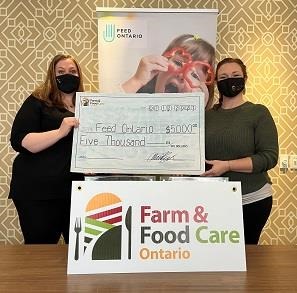
Alicia Becker (right), Farm & Food Care Ontario’s Community Engagement Manager, presents a cheque from FFCO to Feed Ontario’s Amanda King, Director Network and Government Relations.

Toronto - At the end of a successful gardening season, Farm & Food Care Ontario recognized the conclusion of the season of its Garden in a Box program by making a donation to Feed Ontario. Alicia Becker, Community Engagement Manager for Farm & Food Care presented Amanda King, Director Network & Government from Feed Ontario with a cheque for $5000 raised through the program.

Garden in a Box started in the spring of 2021 when participants received a box of seeds, gardening gloves, a gardening journal and the ability to participate in an online community of folks across Ontario learning to garden for the first time.

“Over the last couple of years we’ve seen a growing interest in Ontarians planting their own gardens,” said Becker. “This program was developed to help people get started and build a meaningful connection with farmers and food producers, as well as provide a small scale idea of the variables farmers have to deal with when growing their crops every year.”

“Farmers deal with weather, pests and soil conditions in their fields, and our gardeners got a sense of the decisions farmers have to make every day while taking these considerations into account in their own backyards,” stated Bonnie den Haan, FFCO Chair and Ontario dairy farmer. “It’s important for the public to have a sense of the heartbreak that can be felt and also how wonderful it feels to eat food that you’ve grown through your own hard work.”

A portion of the proceeds from the 500 Garden-in-a-Box kits sold was earmarked for Feed Ontario the province's largest collective of hunger-relief. Together with food banks, industry partners, and local communities, Feed Ontario works to end hunger and poverty by delivering fresh and healthy food, developing innovative programming, and driving change through research and advocacy. On December 7, 2021, that contribution was made to Feed Ontario with the presentation of a cheque from Farm & Food Care Ontario.

“Ontario’s farmers make significant contributions to food banks across the province and we’re pleased to accept this donation from Ontario gardeners as well,” said Amanda King, Director Network & Government Relations at Feed Ontario from Feed Ontario.

Those interested in participating in the 2022 Garden-in-a-Box program should follow FFCO’s twitter or Instagram @farmfoodcareON to watch for the program’s announcement.

Source : Farm & Food Care

Trending Video

The 15-Year Bet Behind Every New Variety

Video: The 15-Year Bet Behind Every New Variety!


Canada is trying to decide how much agricultural research capacity it can afford to lose. Brian Rossnagel believes the better question is whether the country can afford to rebuild it.

The longtime barley and oat breeder makes the case with a simple fact about his profession: the consequences of today’s decisions may not become visible for 10 or 15 years.

“Pick the right parents. That’s the biggest thing,” Rossnagel says. “If you pick the wrong parents, you’re not going to get anywhere—and you don’t know that until 10 years, 15 years later.”

That warning carries particular weight as Agriculture and Agri-Food Canada moves to reduce spending and streamline parts of its science operations. The department’s 2026–27 plan anticipates the loss of approximately 665 positions by 2028–29 and says some research will be reduced where capacity exists in academia or industry. AAFC says the changes will make its science operations more cost-effective over the long term.

For Canada’s seed industry, Rossnagel’s career illustrates what is at stake.

This fall, the retired University of Saskatchewan breeder will be inducted into the Canadian Agricultural Hall of Fame. During his 35-year career at the Crop Development Centre, he helped develop more than 100 barley and oat varieties, including CDC Austenson—one of Western Canada’s most widely grown feed barleys. His induction recognizes not only those varieties, but the collaboration and research system that made them possible.

Rossnagel is quick to emphasize that none of it was the work of one person.

“The first thing I thought about was all the other people who contributed to whatever success I and my program had over the years,” he says. “We know that it’s not an individual who does this. It’s a group—a team.”

That team extends well beyond the breeder whose name appears beside a variety. It includes technicians, pathologists, quality specialists, statisticians, regional testing sites, seed growers and industry partners. It also includes the breeders who came before and those who will carry the germplasm forward.

CDC Fraser barley, for example, moved through three breeding careers. Its parents came from Brian Harvey’s program. Rossnagel advanced the material after Harvey retired, and Aaron Beattie later guided it through registration and release.

That kind of handoff is normal in plant breeding. The person who makes the original cross may never see the resulting variety reach farmers.

It also explains why lost research capacity cannot simply be switched back on when budgets improve.

“If you shut it off, it’s very, very difficult—and particularly costly—to start it up again,” Rossnagel says. “If you have to start from scratch, it’s going to be at least 10 years before anybody notices whether you’re getting anything done or not.”

The concern is not simply how many experimental lines Canada can process. Modern equipment, statistical tools and genetic technologies allow today’s breeding programs to evaluate tens of thousands of lines—far more than Rossnagel could handle when he entered the field in the early 1970s.

But efficiency and automation do not generate every idea.

“If you pare back down, and instead of having six or seven individual scientists concentrating on wheat breeding, you go down and say three people could handle all this, well, that’s half the ideas gone,” he says. “Particularly if you happen to lose the three people who had the really neat and innovative ideas, boy, that’s a problem.”

It is a timely distinction for Canadian agriculture. Consolidating programs may preserve the volume of material moving through a system, at least initially. It may not preserve the diversity of thinking, regional knowledge or willingness to pursue unconventional crosses.

That regional knowledge matters because Canadian agriculture is not one uniform production environment. A variety suited to southern Alberta may face different disease, moisture and maturity pressures than one grown in Manitoba, Ontario or Atlantic Canada.

“Agriculture is applied biology,” Rossnagel says. “Biology, all around the Earth, moves from the poles to the equator. It does not move from Newfoundland to B.C. like politics do.”