How does physical conformation relate to economically important traits in today’s dairy industry? A recent study completed by Holstein Association USA aimed to assess these relationships using linear classification data and DHIA production records. The dataset covered almost 20 years of data and includes over 1 million cows. The results of this study clearly show that cows with more correct, functional conformation live longer and produce more milk.
Linear type classification programs are well established as a method for assessing physical conformation of economically important traits. Cows with higher scores are closer to the ideal physical conformation for a Holstein cow.
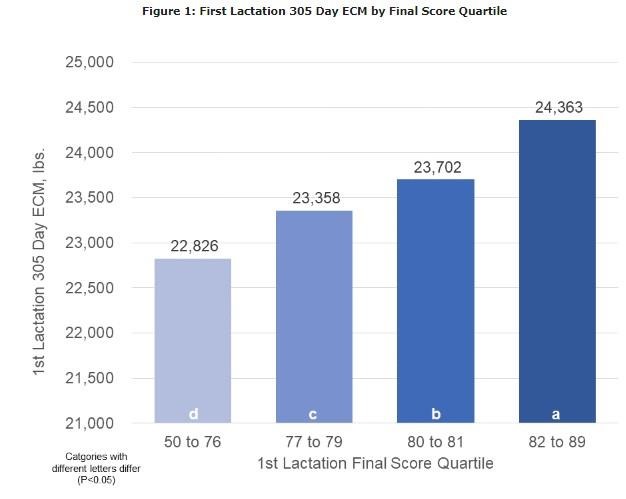
Cows included in the analysis were split into quartiles, with an equal number of cows in each quartile (refer to Figure 1). First lactation cows in the top quartile for final classification score (final scores between 82 and 89 points) produced 1,537 pounds more energy corrected milk in 305 days than those in the bottom quartile (76 points and lower). Using a long-term milk price, of $20/cwt, this difference represents $307 more in gross revenue in their first lactation.
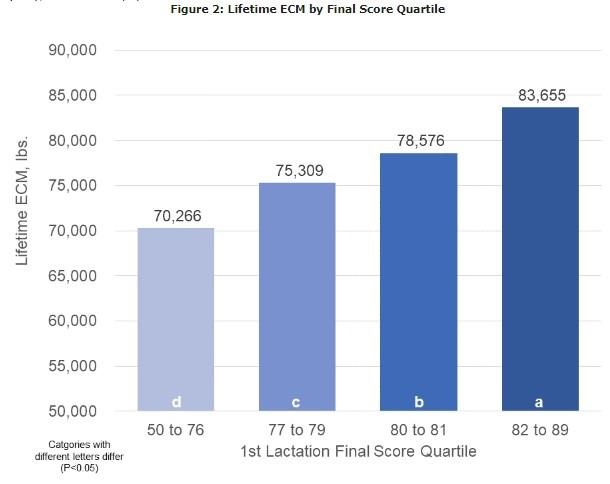
Looking at lifetime energy-corrected milk (ECM), comparing the top quartile to the bottom quartile, the highest scored cows produced 13,389 more pounds of ECM across their lifetimes than cows in the bottom quartile (refer to Figure 2). Using a long-term milk price, of $20/cwt, this difference represents $2,678 more in gross milk revenue per cow over the course of their lives. Among individual linear classification traits udder and feet and leg traits were most corelated with milk yield and longevity measures. Additionally, when look at lifetime days in milk (DIM), cows in the top quartile for final classification score had 142 more lifetime DIM than cows in the bottom quartile.
This large dataset provides new insight into the importance of physical conformation to production and longevity. These results also show that linear classification does quantify economically important physical conformation traits well. As the dairy industry focuses sustainability, breeding cows that last longer is increasingly important. These results demonstrate the importance of selection for functionally correct dairy cows for dairy profitability.
If you are interested in seeing more information about individual traits, you can find a compete report with all analyses at www.holsteinusa.com/typematters. Contact Holstein USA Analytics and Innovation Scientist Jeffrey Bewley by email at jbewley@holstein.com or call 859.699.2998 for questions or further information.
Source : Holstein USA