Recent crop reports from Western Canada have described the effects of record-high temperatures and lack of rainfall that have stressed crops. These reports indicate that some crops have matured faster than normal, or stagnated in their development. The longer these conditions persist, the greater the negative impact will be on crop and hay yields, grain quality and ultimately, farm cash receipts.
In mid-July, the Alberta government reported that 36.6% of the crops were in good to excellent condition compared with the five-year average of 74.1%. Saskatchewan Agriculture and Food reported that the majority of the crops were rated in poor to good condition. Manitoba Agriculture-Food and Rural Initiatives reported that topsoil moisture continued to decline, with crop, hay and pasture conditions all deteriorating at the same time. The first cut of hay in Manitoba was completed with little expectation of a second cut in most parts of the province unless significant rains arrive, coupled with cooler temperatures.
Weather and soil moisture conditions vary across Western Canada
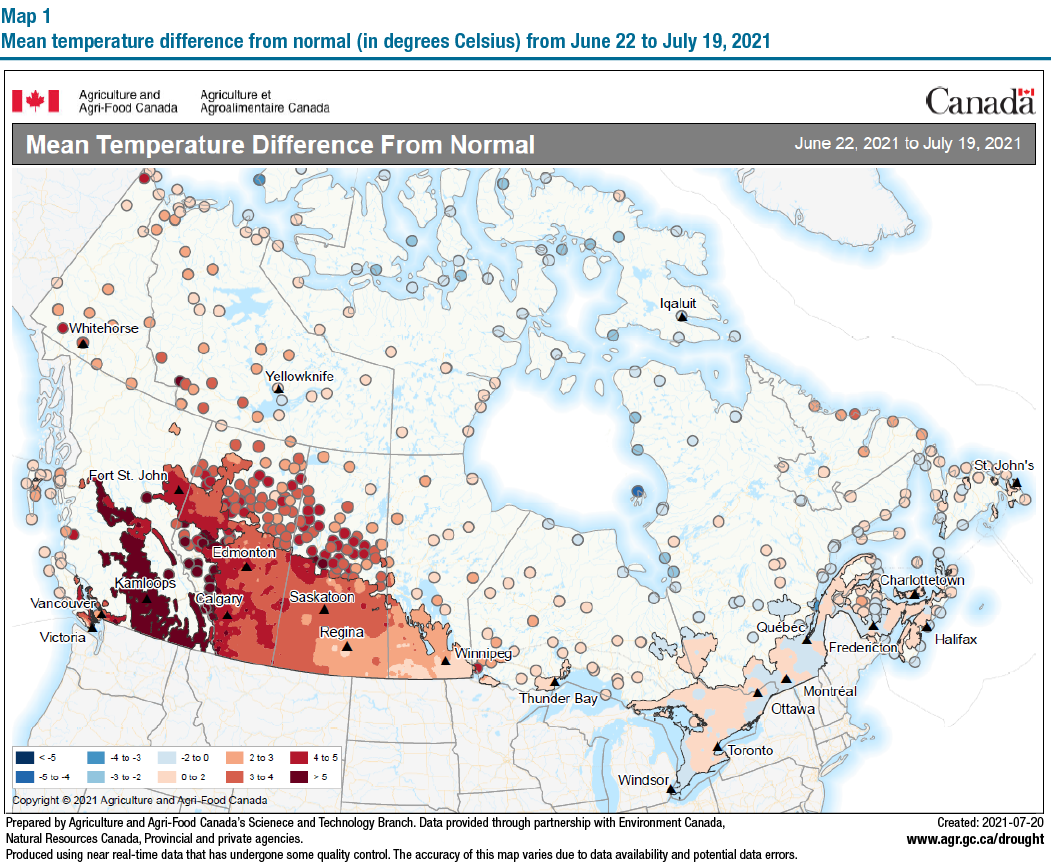
A large proportion of crop production in Canada occurs on the Prairies where farmers have faced challenging weather and soil moisture conditions so far this year. Western Canada experienced above-average temperatures for the last month that progressively intensified from Manitoba through to British Columbia (Map 1).
Since April 1, most of the Prairies received from 40% to 85% of average precipitation since the beginning of the growing season, while the interior of British Columbia has received less than 40% of average precipitation (Map 2).

The concern expressed by many farm operators is that the current drought conditions have hit at the worst time of crop development. In canola, for example, flowering can become heat stressed beyond 30°C which can lead to smaller or aborted pods, fewer seeds per pod and ultimately lower yields.
How Statistics Canada monitors the impact of the drought on crop development
Statistics Canada monitors crop conditions on a weekly basis using coarse resolution satellite imagery as part of the Crop Condition Assessment Program (CCAP), which is funded by Agriculture and Agri-Food Canada. The CCAP uses the Normalized Difference Vegetation Index (NDVI) to monitor changing crop and pasture conditions. Based on the NDVI, for the week of July 19 to 25, 2021, growing conditions are lower to much lower for most of the Prairies and British Columbia compared with normal (Map 3).
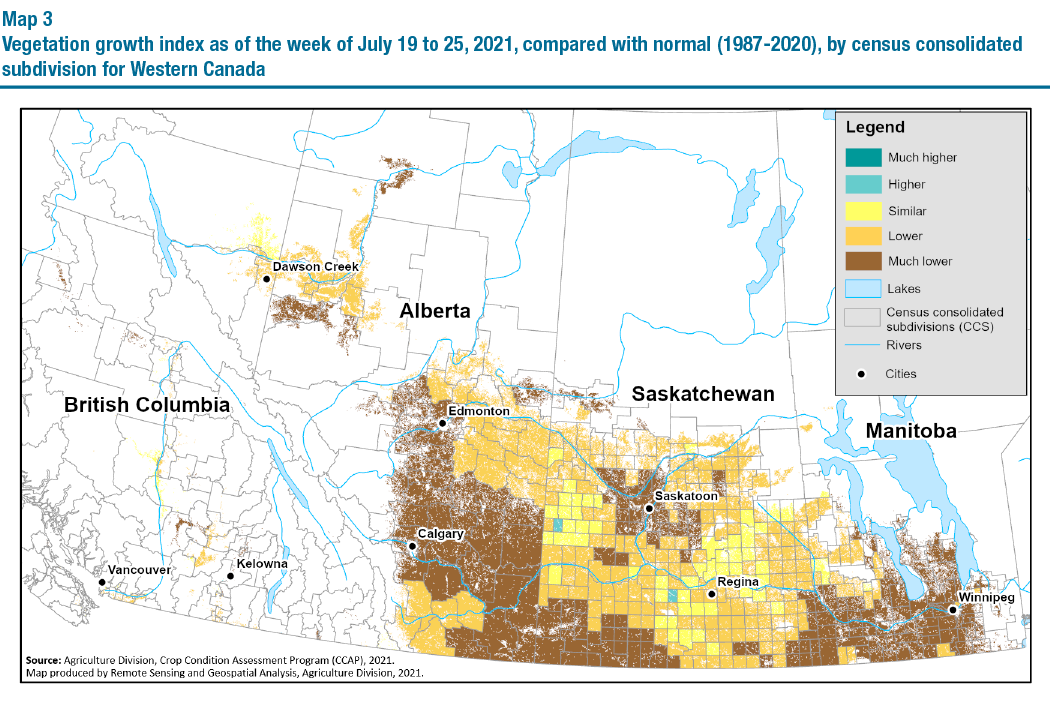
With the CCAP, the geographic extent of crop conditions and the degree of change by region can be compared with the normal for any region of Canada. When the current NDVI value is higher than the average, crops are greener with higher leaf volume, and when the NDVI value is below the average, crops are less green and have lower leaf volume.
For example, crop conditions in the regions south of Calgary are below last year and below the long-term average, indicating that the drought is now having an impact on the quality of crops in that area (Infographic 1). A similar situation can be found for many other regions of Western Canada.
However, it is important to note that not every region is experiencing the same impact, and conditions may still change in the coming months.
Click here to see more...