Farms.com Home   Farm Equipment News

New Grapples Enhance Productivity Of John Deere Knuckleboom Loaders

To stay ahead of the competition, loggers need to keep up at the landing, and the John Deere 437E and 337E Knuckleboom Loaders are now equipped with new grapples manufactured by John Deere to further improve productivity and machine durability. The E-Series machines deliver five percent more swing torque and lift force over previous models, and the new grapple complements these features by improving rotator torque and response times, and enabling higher side loads and rotator lift capacity. The new grapple, available with a 48- or 52-inch opening, is made with a more durable cast design and a larger, more robust rotator, providing loggers with a heavy-duty machine designed to withstand the toughest of jobs.
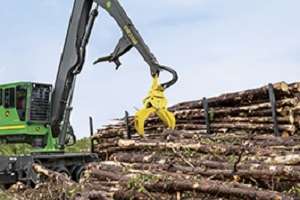


 "If I could describe the new grapple in one word, it would be 'nimble' — and my operator agrees," said Donald Mixon, owner of Mixon Saw Mill in Bermuda, Alabama. "It's smoother, faster and holds wood well during second thinning. Overall, it just feels tough."

 Key Grapple Features

  • Rotator lift capacity: 123,000 pounds
  • Rotator torque: 36,200 pounds/inch
  • Built with high impact and wear-resistant custom steel
     
Click here to see more...

Trending Video

Dicamba Returns for Georgia Farmers: What the New EPA Ruling Means for Cotton Growers

Video: Dicamba Returns for Georgia Farmers: What the New EPA Ruling Means for Cotton Growers

After being unavailable in 2024 due to registration issues, dicamba products are returning for Georgia farmers this growing season — but under strict new conditions.

In this report from Tifton, Extension Weed Specialist Stanley Culpepper explains the updated EPA ruling, including new application limits, mandatory training requirements, and the need for a restricted use pesticide license. Among the key changes: a cap of two ½-pound applications per year and the required use of an approved volatility reduction agent with every application.

For Georgia cotton producers, the ruling is significant. According to Taylor Sills with the Georgia Cotton Commission, the vast majority of cotton planted in the state carries the dicamba-tolerant trait — meaning farmers had been paying for technology they couldn’t use.

While environmental groups have expressed concerns over spray drift, Georgia growers have reduced off-target pesticide movement by more than 91% over the past decade. Still, this two-year registration period will come with increased scrutiny, making stewardship and compliance more important than ever.