Farms.com Home   News

Pollinator Ratings in Soybean Varieties

By Laura Lindsey and Chia Lin et.al

Soybean plants are self-pollinating and do not require insects for pollination. However, soybean fields can provide important floral resources for pollinators, and there is some evidence of pollination by bees improving soybean yield.

In 2022, we screened 128 soybean varieties entered in the Ohio Soybean Performance Trials for nectar production and attractiveness of soybean flowers to bees. Bee activities were observed in all soybean varieties, but nectar production and bee visitation rate were highly variable across varieties (Figure 1). Bee visitation was primarily driven by floral nectar volume and not by flower color or nectar sugar concentration.
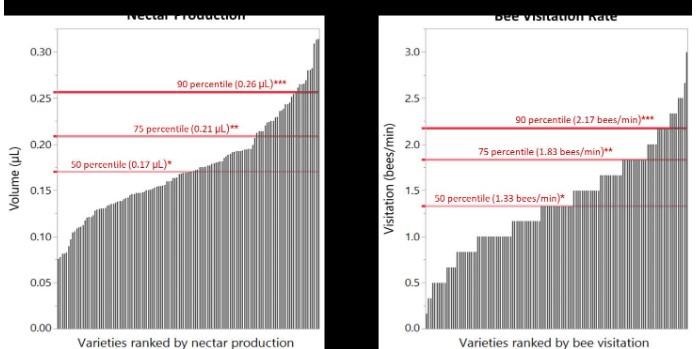
Figure 1. Nectar production and bee visitation rate of 128 soybean varieties evaluated at the Union County location of the 2022 Ohio Soybean Performance Trials

Figure 1. Nectar production and bee visitation rate of 128 soybean varieties evaluated at the Union County location of the 2022 Ohio Soybean Performance Trials.

If you are interested in planting a soybean variety that is also attractive to bees, please see our 2022 Pollinator Ratings in Soybean Varieties Report. This report shows soybean varieties that had a higher nectar volume and bee visitation rate. Additionally, yield information for each variety can be found at: https://ohiocroptest.cfaes.osu.edu/soy2022/ for six locations within Ohio.

Source : osu.edu

Trending Video

Why the Fertilizer Crisis Won’t End When the Iran War Does

Video: Why the Fertilizer Crisis Won’t End When the Iran War Does

The fertilizer crisis didn’t start with war — it revealed a system already under strain.

Seed World U.S. Editor Aimee Nielson breaks down what’s really happening in global fertilizer markets and why the impact on farmers may last far longer than current headlines suggest. Featuring insights from global fertilizer expert Melih Keyman and industry leaders Chris Abbott and Chris Turner, this conversation explores:

Why fertilizer supply was already tight before geopolitical disruption

What the Strait of Hormuz and global trade routes mean for input availability

How rising nitrogen prices are crushing farmer margins

Why this crisis could affect seed choices, crop mix and acreage decisions

The hidden risks around phosphate and sulfur supply

Why experts say this situation may get worse before it gets better

Even if tensions ease, the underlying issues — supply constraints, investment gaps and purchasing behavior — are still in play.

Watch to understand what this means for farmers, the seed industry and the future of global food production.