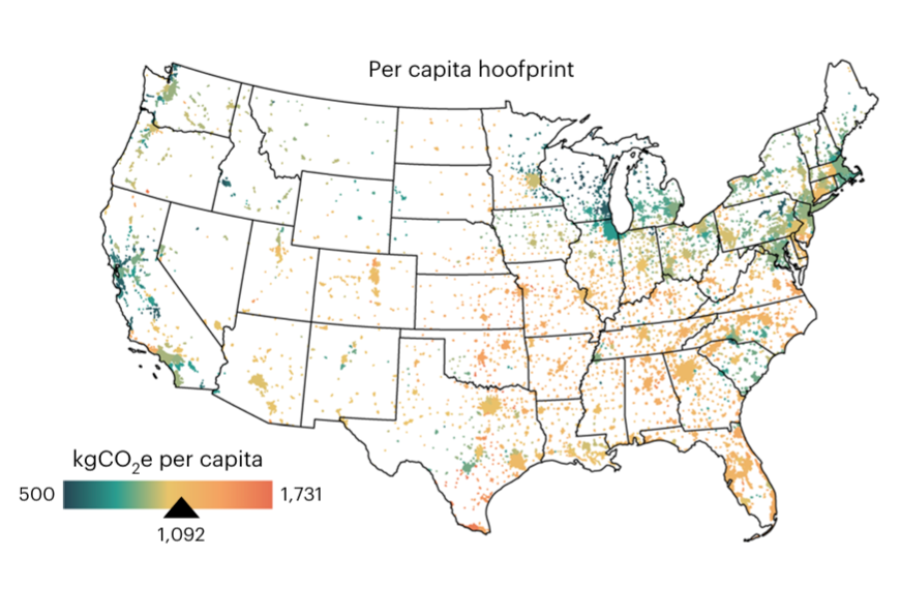
Depending on where you live in the United States, the meat you eat each year could be responsible for a level of greenhouse gas emissions that's similar to what's emitted to power your house.
That's according to new research from the University of Michigan and the University of Minnesota, published in the journal Nature Climate Change. The study provides a first-of-its-kind systematic analysis that digs into the environmental impacts of the sprawling supply chains that the country relies on for its beef, pork and chicken.
Supported in part by the U.S. National Science Foundation, the team calculated and mapped those impacts, which they've dubbed meat's "carbon hoofprint," for every city in the contiguous U.S. While the study does underscore the size of America's urban carbon hoofprint — it's larger than the entire carbon footprint of Italy — it also provides city-specific information that residents and governments can use to make positive changes.
The study found:
- Cities with higher meat consumption were not necessarily correlated with a larger hoofprint. Rather, the link of urban food consumption with rural counties that grow animal feed, raise animals and process animals has the biggest impact on hoofprint size.
Source : umn.edu