Soybean meal is an important source of protein for animal feed, but it’s not perfect.
“Soybean meal contains substances, known as antinutritional factors, that do not harm the animal, but can interfere with digestion,” explained South Dakota State University sophomore Javi Adividya. The microbiology major is using fermentation to break down these antinutritional factors and thereby increase the digestibility of soybean meal.
“Ideally, we want the animals to take advantage of all the nutrition and protein present in the soybean meal. That is the goal,” Adividya said. He will present this research to state legislators March 3 during the Undergraduate Legislative Poster Session.
Adividya’s research adviser is assistant professor Bishnu Karki of the Department of Biology and Microbiology. The research is supported by U.S. Department of Agriculture Hatch funding through the South Dakota Agricultural Experiment Station.
Adividya, a Bogor, Indonesia, native, said, “At first, I wanted to be a doctor, but I am really shy, so I wanted to work behind the scenes—research allows me to do exactly that.” He became interested in microbes during high school. “Microbes are interesting because there are a lot of ways we can use them for our benefit,” Adividya pointed out.
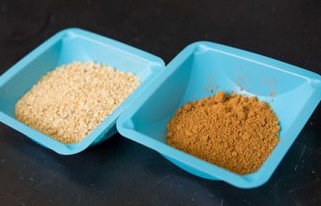
The soybean meal, on the right, has been fermented for 120 hours using microbes that can hydrolyze proteins and fibers, while the one on the left is natural/unfermented. The next step will be to analyze the protein, phenolics, phytics and sugars in the samples.
He is using three fungal microbes to ferment the soybean meal. According to Adividya’s mentors, graduate students Ahmad Alhomodi and Camille Massmann, each microbe has a different enzymatic ability and a different metabolic process.
“One may be good at breaking down fiber and another at breaking down large protein groups into smaller ones that the animal can digest,” Massmann said. “If we combine them, we hope to decrease antinutritional factors and to get more digestible protein.”
Alhomodi, who is doing similar experiments on canola meal, added, “The microbes break down the complex carbohydrates into simpler sugars, like glucose, using enzyme complexes and produce digestible protein concentrates that can be supplemented in animal diets.”
“We are using set of microbes in combination to reduce the level of antinutritional factors present in agricultural products, like oilseed meals,” Adividya said. He ferments the soybean meal for 120 hours and takes samples every 24 hours. After completing the fermentation trials, he will analyze the protein, phenolics, phytics and sugars to determine the processing time needed to get the best results.
“Through value-added processing, we are making a more highly digestible protein product,” Adividya concluded.
Source : sdstate.edu