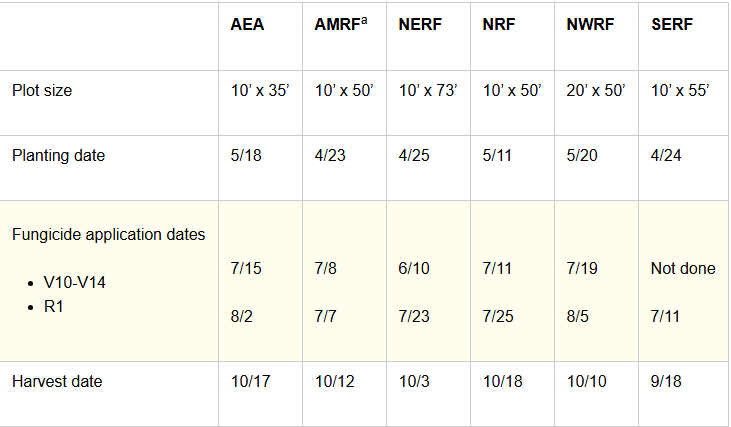
In 2024, the effect of commercial fungicides on foliar diseases of corn were evaluated at six Iowa State University Research and Demonstrations Farms: the Northwest Research and Demonstration Farm (NWRF, Sutherland), Northern Research and Demonstration Farm (NRF, Kanawha), Northeast Research and Demonstration Farm (NERF, Nashua), Central Iowa Research and Demonstration Farms, (AEA, Boone), Armstrong Memorial Research and Demonstration Farm (AMRF, Lewis), and Southeast Research and Demonstration Farm (SERF, Crawfordsville). All sites had a history of soybean in 2023. Hybrid planted was at the farm’s discretion. Plot size, planting, fungicide application, and harvest dates, are shown in Table 1. Depending on the location, fungicides were applied with a knapsack or ground rig sprayer.
Table 1 Hybrid, plot size, planting, fungicide application, and harvest dates at each location where foliar fungicides were evaluated on corn in 2024.
Results summary
Effect of fungicides on foliar disease. In Iowa in 2024, leaf diseases of corn varied among ISU research farm locations (Fig. 1 and 2). At the Northwest Research Farm (NWRF), Armstrong Memorial Research Farm (AMRF) in southwest Iowa, and the Ag Engineering and Agronomy Farm (AEA) in central Iowa, southern rust and tar spot were observed. At R5.5, mean southern rust severity on the ear leaf was 3.8% and 9.0% while tar spot severity on the ear leaf was 5.3% and 2.4 %, at NWRF and AMRF, respectively. At AEA, mean southern rust severity at the plot level was 3.0 on a 1-4 scale where 1 = no disease and 4 = entire canopy affected with southern rust while mean tar spot severity on the ear leaf of the control at R5 was 1.9%. At the Northern Research Farm (NRF), southern rust was prevalent with 5.0% severity on the ear leaf at R5.5. Conversely, at the Southeast Research Farm (SERF), tar spot was severe with a mean of 14.9% on the ear leaf at R5.5. Disease severity was very low at the Northeast Research Farm (NERF)(tar spot <1%; southern rust 2.3% on the ear leaf at R5.5).
Differences in the effectiveness of fungicides at reducing disease were observed at AEA, AMRF, NRF, NWRF and SERF. For tar spot, Delaro Complete, Miravis Neo, and Veltyma, all applied at R1 significantly reduced tar spot compared to the non-sprayed check at three of the four locations where tar spot severity was >2% on the ear leaf of the non-sprayed check at R5 (Fig. 1). Only Aproach Prima, Miravis Neo, and Veltyma, all applied at R1 significantly reduced southern rust compared to the non-sprayed check at all four locations where the disease was observed (Fig.2).
Fig. 1. Effect of fungicides on tar spot at four locations in Iowa in 2024. Unless noted, fungicides were applied at R1 at all locations except AMRF where they were applied at R3.
Fig. 2. Effect of fungicide on southern rust at four locations in Iowa in 2024. Unless noted, fungicides were applied at R1 at all locations except AMRF where they were applied at R3.
Effect of fungicides on yield. No differences in yield were detected among treatments at all locations (P>0.1; Table 1). However, a significant relationship disease suppression and yield response was detected for tar spot at AMRF and SERF, and for southern rust at AMRF (P<0.1; data not shown). Greater yield responses were associated with better disease control.
Table 2. Yield of corn treated with a foliar fungicide at six locations in Iowa in 2024. Unless noted, fungicides were applied at R1
Management recommendations
The data support data from previous years and from surrounding states that the best time to apply a fungicide to reduce disease is at silking. Moreover, depending on the product used, one application can be enough to effectively reduce disease through grain fill and thereby protect grain fill.
Source : iastate.edu