By Alison Robertson
In pathology, we joke that to control a disease, just put a research plot out, and you’re guaranteed no disease. A couple of days ago I blogged about tar spot, hoping for a similar effect. Alas, yesterday evening, I received a report of that dreaded black spot in Marshall County, central Iowa (Figure 1).
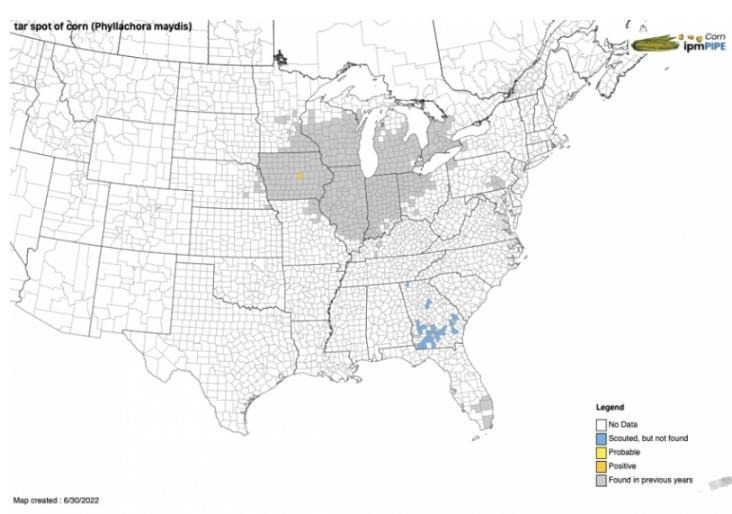
Figure 1. Tar spot was confirmed in Marshall County, IA on V11 corn on 30 June 2022 (corn.ipmpipe).
The report came from a seed company agronomist who was out scouting some competitive hybrid plots. Incidence was low (approximately 1% plants with signs). Growth stage of the corn was V11.
Tarspotter forecasts Marshall County at high risk for tar spot. In fact, most of Iowa has been at high risk for June. It is VERY important to get out and scout fields. Look for tar spot signs, small black circular-to-irregular shaped spots that cannot be scratched off the leaf surface in the lower canopy (Figure 2).
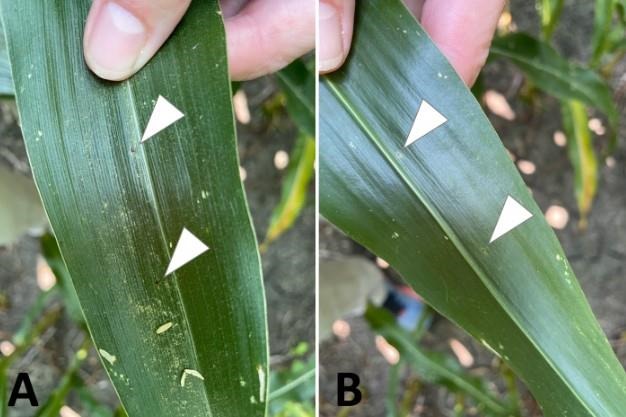
Figure 2. Early signs of tar spot are small, black circular to irregular raised spots visibile on both the upper (A) and lower (B) leaf surfaces
Iowa State University still recommends that a fungicide be applied no earlier than V12. This is based on data from WI, IL, IN, MI and Ontario, Canada from field trials done over the past five years. Moreover, tar spot should be present in the field, increasing in incidence (number of plants with signs of tar spot), and environmental conditions favorable for tar spot development (wet leaves for several hours). Fields that are sprayed prior to tasseling, may require a second application of fungicide three to four weeks later, if conditions remain favorable for tar spot development.
Source : iastate.edu