Farms.com Home   News

Trust is a Dairy Superpower

What makes dairy so valued that milk alone is in 94 percent of U.S. refrigerators? Nutrition is one factor. So is affordability. But perhaps the greatest value is one that data supports: People trust it.

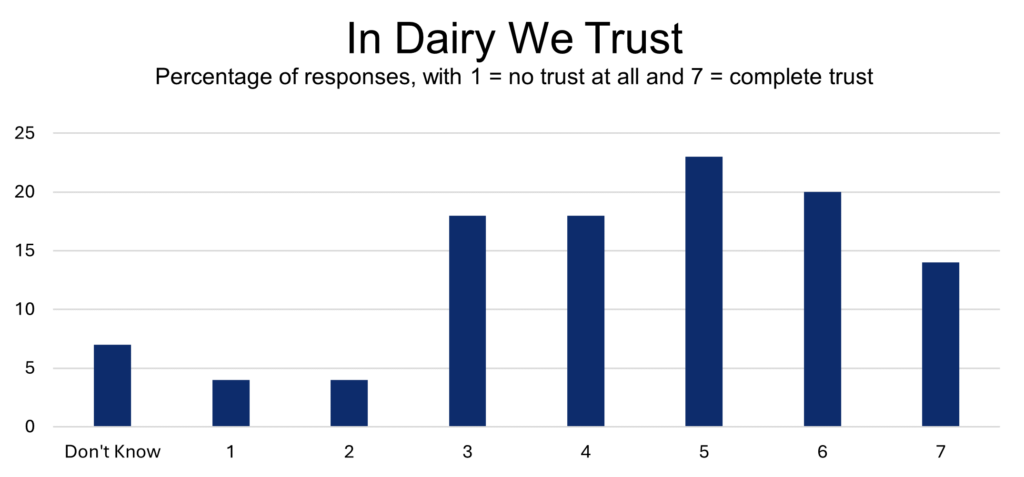
The dairy checkoff’s latest consumer perception tracker, conducted by Kantar Group, shows just how much confidence dairy has from consumers – and it’s a great contrast to the loud braying of the anti-dairy fringe, which takes up more brain space among the sane and grounded than should. Rated on a 1-7 scale of trust, with 1 being none and 7 being total, 58 percent of consumers rated dairy at 5 or above, according to the nationally representative sample of consumers aged 13-65.
crop

That same survey, conducted last November and December, showed 35 percent either strongly or completely trusting dairy, shown by ratings of 6 and 7. That high trust level held across generations. Baby boomers led at 38 percent of strong or complete trust; Generation X, a cohort famed for trusting no one, was lowest at 33 percent. And the future looks stable and bright. About 34 percent of teenagers strongly or completely trusted dairy, with young adults at 35 percent and Millennials at 36. And again, these were the highest ratings of trust – including less-fervent support, clear majorities spanned generations.


Click here to see more...

Trending Video

Finding a Balance of Innovation and Regulation - Dr. Peter Facchini

Video: Finding a Balance of Innovation and Regulation - Dr. Peter Facchini

Regulations help markets and industry exist on level playing fields, keeping consumers safe and innovation from going too far. However, incredibly strict regulations can stunt innovation and cause entire industries to wither away. Dr. Peter James Facchini brings his perspective on how existing regulations have slowed the advancement of medical developments within Canada. Given the international concern of opium poppy’s illicit potential, Health Canada must abide by this global policy. But with modern technology pushing the development of many pharmaceuticals to being grown via fermentation, is it time to reconsider the rules?

Dr. Peter James Facchini leads research into the metabolic biochemistry in opium poppy at the University of Calgary. For more than 30 years, his work has contributed to the increased availability of benzylisoquinoline alkaloid biosynthetic genes to assist in the creation of morphine for pharmaceutical use. Dr. Facchini completed his B.Sc. and Ph.D. in Biological Sciences at the University of Toronto before completing Postdoctoral Fellowships in Biochemistry at the University of Kentucky in 1992 & Université de Montréal in 1995.