By Saoimanu Sope
Sugar-feeding ants protect pests that infect trees and damage the fruit they bear. Insecticides are often a go-to solution, but may kill beneficial insects in the process, too. Thankfully, Mark Hoddle, University of California Cooperative Extension entomologist and biological control specialist at UC Riverside, together with UCR colleagues in chemical engineering, developed a biodegradable hydrogel baiting system that targets ant populations, which protect sap-sucking pests from their natural enemies. Control of ants allows beneficial parasitoids and predators to greatly reduce pest populations.
Deciding to expand Hoddle's research was a “no-brainer” according to David Haviland, UC Cooperative Extension farm advisor in Kern County.
Haviland is investigating active ingredients that can be effectively used in hydrogel baiting systems. His research builds on Hoddle's use of alginate gels, also known as water beads, soaked in sugar water to control Argentine ants.
“What we're doing in California can benefit places like Florida, Texas, Mexico and beyond,” Haviland said.
Sugar-feeding ants are a universal problem as they interfere with biocontrol processes and promote diseases like huanglongbing, or citrus greening, because there are more vectors to spread disease-causing organisms between trees.
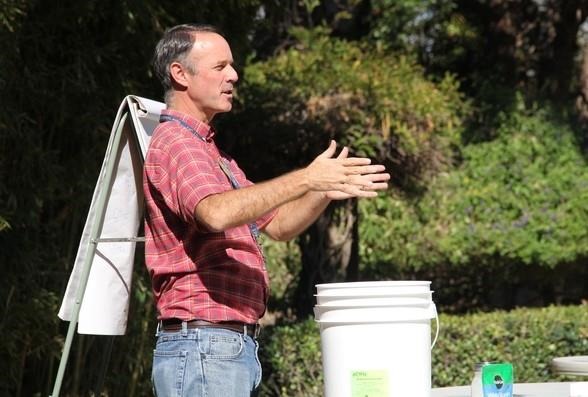
David Haviland sharing his research at the Argentine Ant and Citrus Pest Management Field Day in Redlands in October 2022. All photos by Saoimanu Sope.
The Hoddle lab conducted two years of orchard research showing that when ants are controlled, the amount of citrus flush infested with Asian citrus psyllid (ACP), a mottled brown insect that vectors the pathogen causing citrus greening, decreases by 75%. Citrus flush refers to newly developed leaves.
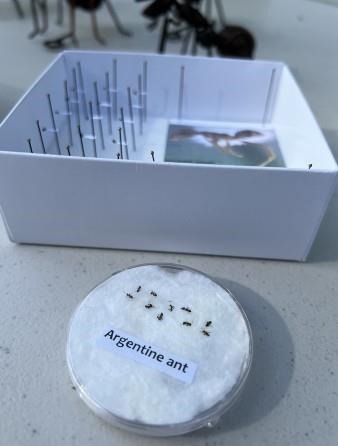
A display of Argentine ants at the Argentine Ant and Citrus Pest Management Field Day in Redlands in October 2022.
“But benefits are not restricted to just ACP with Argentine ant control, as natural enemies destroy colonies of other sap-sucking pests too,” said Hoddle. “For example, citrus mealybug infestations on leaves were completely eliminated by natural enemies, 100% control, while densities of fruit infested by mealybugs were reduced by 50%.”
The Hoddle lab's success inspired Haviland to consider how this approach will fare in different regions of the state where there are different crops, different pests and different ant species.
Haviland has worked for many years on solid baits that are effective and affordable for ants that feed primarily on protein, like fire ants in almonds, but successful control measures for sugar-feeding ants that drink their food have been elusive.
“Therefore, we're using hydrogels to essentially turn a liquid bait into a solid, making it effective and commercially adoptable,” Haviland said. He and his team are assessing whether active ingredients that undoubtedly work against ants, like thiamethoxam, maintain their effects in a hydrogel system.
Unlike Hoddle's biodegradable alginate gels, Haviland is relying on acrylamide gels that are similar to the absorbing material you would find in a diaper. These gels are not organic, but are currently accessible on a commercial scale, and have been shown to be effective in wine grapes on the North Coast by a Cooperative Extension advisor in Napa County, Monica Cooper. Haviland's current research efforts are focused on citrus, table grapes and wine grapes in the San Joaquin Valley, and on lemons on the coast.
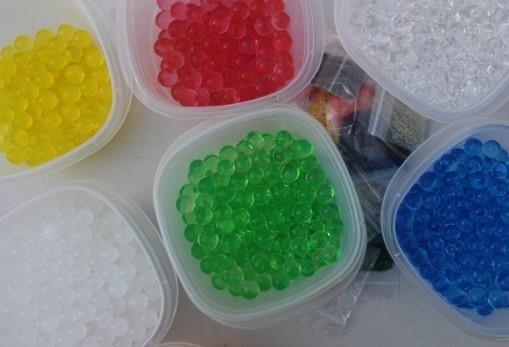
Hoddle's hydrogel baiting system uses alginate gels.
The primary challenge now is navigating pesticide regulations and registration.
“This is cutting-edge research,” Haviland said, and manufacturer labels for the products being used need to be updated to include hydrogels as an approved use. This process takes time. Additionally, adding new product uses needs to make economic sense for the manufacturer.
Hoddle and Haviland's research can provide data for adding these methods to the product labels.
“If we can show that this tech works against lots of pests, lots of ant species, in lots of different crops across California, hopefully we'll achieve a critical mass of benefits that motivates product manufacturers to make modifications to their labels,” said Haviland.
Haviland is hopeful about the process, and said he believes that UC ANR is in a prime position to lead innovation for an issue that requires collaboration among specialists, advisors and the industry.
Source : ucanr.edu