By Erin Lizotte
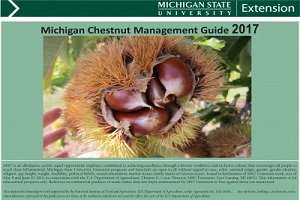
In an effort to assist chestnut growers in making pesticide and nutrient management decisions, an updated “Michigan Chestnut Management Guide 2017” has been created and is available at the Michigan State University Extension Chestnuts page. The packet includes a listing of registered pesticides, nutrient management recommendations and a guide to seasonal pest occurrence in Michigan.
To protect yourself, others and the environment, always read the label before applying any pesticide. Although efforts have been made to check the accuracy of information presented in the “Michigan Chestnut Management Guide,” it is the responsibility of the person using this information to verify it is correct by reading the corresponding pesticide label in its entirety before using the product.
Reference to commercial products or trade names does not imply endorsement by MSU Extension or bias against those not mentioned. Information presented here does not supersede the label directions.
This material is based upon work supported by the National Institute of Food and Agriculture, U.S. Department of Agriculture, under Agreement No. 2015-09785. Any opinions, findings, conclusions, or recommendations expressed in this publication are those of the author(s) and do not necessarily reflect the view of the U.S. Department of Agriculture.
Source: msu.edu