By Ryan Hanrahan
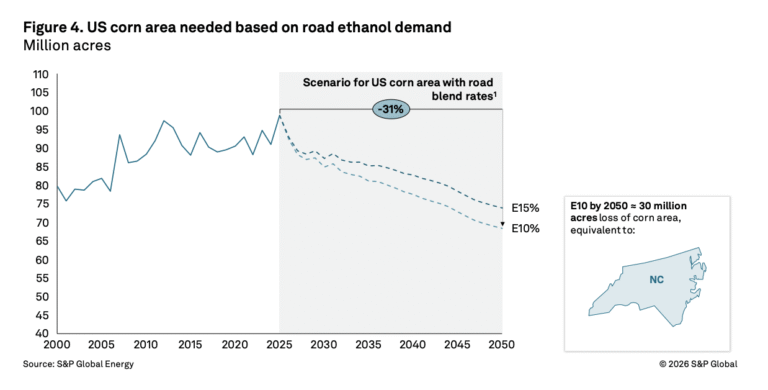
Progressive Farmer’s Jake Zajkowski reported that “a new report from U.S. Farmers and Ranchers in Action and its partners predicts the U.S. could lose roughly 30 million corn acres by 2050 if new sources of feed demand are not found and the ethanol blending rate remains at 10%.”
“The study, completed by S&P Global Energy’s consulting group, created a high-growth, optimized scenario where technology is not limited by food and fuel demand,” Zajkowski reported. “New markets, such as year-round E15, maritime fuels and aviation fuels, could pave the way for farm profitability and rural prosperity.”
“The report entitled ‘Fueling Agriculture: Biofuels as The Catalyst’ said a higher blend rate, in addition to a convergence of technology, would ‘lift U.S. corn yields by 1.6% annually through 2050, unlocking nearly 50% more production without expanding acreage,'” Zajkowski reported. “At the current blend rate, the U.S. would progressively lose ethanol market share as gasoline consumption declines, resulting in a loss of 6.6 billion gallons of ethanol demand by 2050. The land mass lost, the report estimates, would be 30 million acres, equivalent to halting production on a land mass the size of North Carolina.”
Bloomberg’s Elizabeth Elkin reported that “expanding biofuel demand would allow agricultural production to remain strong, serving as a ‘reliable long-term supplier’ of corn, ethanol and other products to domestic and international markets, the report said. About 83% of the net increase in corn demand since 2000 has been attributed to ethanol expansion, according to the study.”
Source : illinois.edu