Farms.com Home   News

Vegetables and Pulses Outlook, April 2020 (summary)

Per Capita Availability Rises in 2019

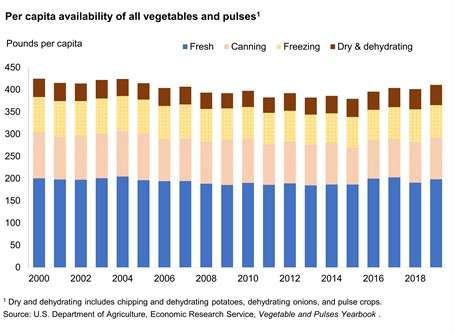
In 2019, total U.S. per capita vegetable use (availability) increased 2 percent to 409 pounds. Except for pulse crops, all major categories exhibited increases. Availability of pulse crops dropped 23 percent as pinto and navy bean output slipped, while chickpea and lentil production declined sharply on reduced area. Recovering from a 6 percent drop in 2018, fresh-market vegetable availability (including potatoes) rose 4 percent to 198 pounds in 2019. In fact, 16 of the top 25 fresh-market vegetables posted gains in availability driven largely by increases for spinach, cauliflower, cabbage, carrots, green beans, and potatoes.

Although processing availability increased in 2019, canning uses accounted for all the gain with vegetables for freezing declining 2 percent. After declining in 2017, per capita canning availability increased for the second consecutive year. In 2019, it rose 3 percent to 94 pounds−the highest level since 2010. Increases were noted for many of the top canning vegetables, with most of the gain from processing tomatoes.
Source : usda.gov

Trending Video

Evolution of Beef Cattle Farming

Video: Evolution of Beef Cattle Farming

The Clear Conversations podcast took to the road for a special episode recorded in Nashville during CattleCon, bringing listeners straight into the heart of the cattle industry. Host Tracy Sellers welcomed rancher Steve Wooten of Beatty Canyon Ranch in Colorado for a wide-ranging discussion that blended family history and sustainability, particularly as it relates to the future of beef production.

Sustainability emerged as a central theme of the conversation, a word that Wooten acknowledges can mean very different things depending on who you ask. For him, sustainability starts with the soil. Healthy soil produces healthy grass, which supports efficient cattle capable of producing year after year with minimal external inputs. It’s an approach that equally considers vegetation, animal efficiency, and long-term profitability.

That philosophy aligned naturally with Wooten’s involvement in the U.S. Roundtable for Sustainable Beef, where he served as a representative for the Colorado Cattlemen’s Association. The roundtable brings together the entire beef supply chain—from producers to retailers—along with universities, NGOs, and allied industries. Its goal is not regulation, Wooten emphasized, but collaboration, shared learning, and continuous improvement.