By Bennett Rosenberg
Agriculture could produce up to 38 percent of U.S. greenhouse gas emissions in 2050.
Here’s why: Every other sector of the economy, especially transportation and energy, is expected to reduce emissions dramatically. But emissions from agriculture will likely hold steady.
Agriculture’s contribution to the climate crisis
Agriculture is responsible for at least 10 percent of annual U.S. greenhouse gas emissions. When combined with emissions from fertilizer production, the sector’s share is even higher.
If these emissions remain steady while emissions from other sectors fall, agriculture’s share of U.S. emissions will grow, according to climate models.
Under current U.S. policies, emissions from transportation and electricity should fall substantially by 2050 while emissions from agriculture hold steady. In that scenario, agriculture’s share of U.S. emissions could nearly double from existing levels, topping 18 percent.
But if emissions from other sectors fall in line with aggressive U.S. international commitments, agriculture’s share could hit 38 percent by mid-century.
Figure 1: U.S. emissions by economic sector in 2022 and predicted emissions in 2050 under two scenarios.
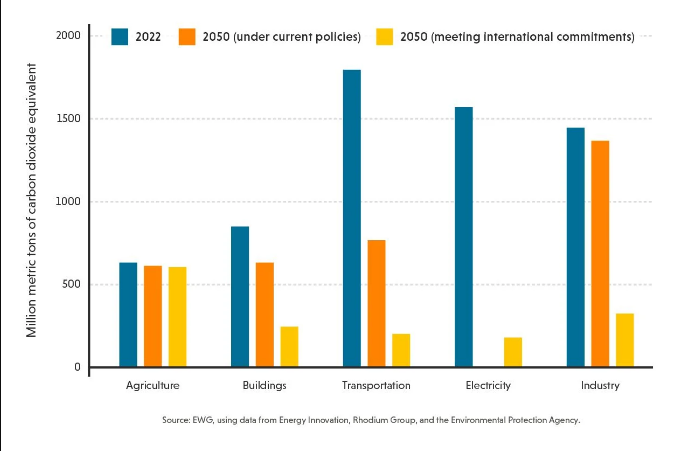
Figure 2. If the U.S. follows its international commitments, agriculture could approach 40 percent of emissions by mid-century.
Scientists warn if emissions from agriculture don’t go down, the worst impacts of the climate crisis will be inescapable.
Agriculture reductions key to addressing climate crisis
Farmers’ adoption of well-known practices that reduce greenhouse gas emissions could significantly reduce emissions from agriculture, according to a report from the Boston Consulting Group and the Walton Family Foundation.
Simply changing practices used to produce the nation’s food could slash greenhouse gas emissions from farming by almost 22 percent, according to the report.
The report also considered changes in how fertilizer is used in addition to reforms in tillage practices and grazing management, the use of cover crops, feed additives and soil amendments, and the targeted use of trees.
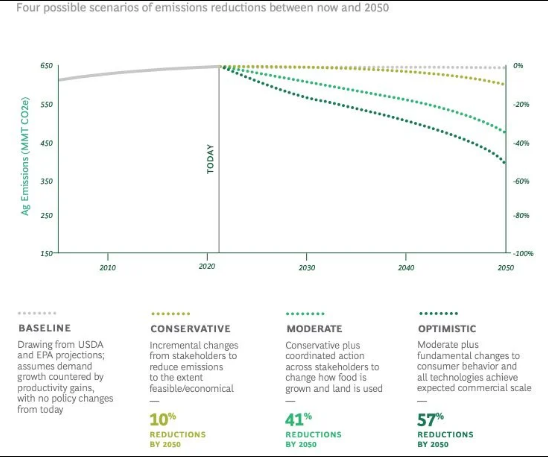
When combined with dietary changes that lower meat consumption and food waste, emissions from food could fall by 57 percent, the report says. That’s about 368 million metric tons of carbon dioxide, or MMT CO2e, or more than Argentina’s total annual emissions.
Figure 3: Scenarios for reducing agriculture’s emissions by 2050.\
Farm policy reforms are needed to make climate crisis a priority
Before the Inflation Reduction Act became law, the Agriculture Department’s Environmental Quality Incentives Program, or EQIP, sent $5.4 billion to farmers between 2017 and 2022. Less than one-third of EQIP funds went to “climate-smart” practices that reduce emissions or sequester carbon in the soil.
Click here to see more...