Farms.com Home   Ag Industry News

Grazing cover crops

Grazing cover crops

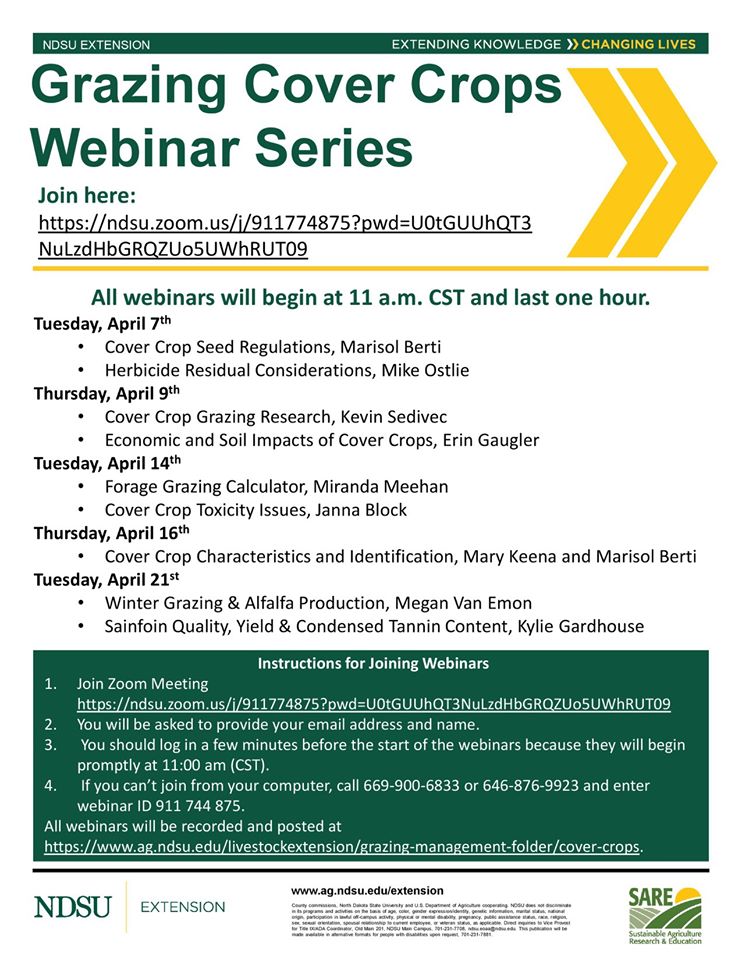
North Dakota State University is hosting a series of free webinars on the topic

By Diego Flammini
Staff Writer
Farms.com

North Dakota State University (NDSU) is providing an opportunity for livestock producers to learn about grazing cover crops during a free webinar series.

Extension specialists and researchers will make live presentations and answer questions during the series webinars. Each event is one-hour long and the first in the series is scheduled for Tuesday, April 7.

Two webinars will be offered on some days, and the presentations will begin at 11 a.m. CST.

The topics represent a mix of extension research and information producers are looking for, said Miranda Meehan, livestock environmental stewardship specialist with NDSU Extension.

“For the past few years we’ve been doing café talks on soil health and one of the things that keeps coming up is grazing cover crops and getting livestock integrated into crop systems,” she told Farms.com.

Marisol Berti, a forage and biomass crop production professor, will lead the first webinar on April 7.

Her presentation will focus on cover crop seeding regulations, a topic that producers may be unfamiliar with, Meehan said.

“It’s a really interesting conversation because those seed sources aren’t as regulated as some of our crop species,” she said. “There’s a higher chance you get weed seeds in those cover crop seeds, so (Berti) is going to talk about some of the precautions producers can take.”

Producers are interested in the information the presenters are going to share.

“We’re always open to more education and suggestions,” Erika Kenner, a Simmental producer from Leeds, N.D., told Farms.com. “We used cover crops in the past by seeding it into a crop we had harvested already. We found it was great for grazing in the fall and winter.”

The webinars will be broadcast using Zoom and are limited to the first 100 participants.

NDSU will record each webinar and post them online for later viewing.

Trending Video

How farmers are protecting the soil and our food security | DW Documentary

Video: How farmers are protecting the soil and our food security | DW Documentary

For a long time, soil was all but ignored. But for years, the valuable humus layer has been thinning. Farmers in Brandenburg are clearly feeling the effects of this on their sandy fields. Many are now taking steps to prepare their farms for the future.

Years of drought, record rainfall and failed harvests: we are becoming increasingly aware of how sensitively our environment reacts to extreme weather conditions. Farmers' livelihoods are at stake. So is the ability of consumers to afford food.

For a few years now, agriculture that focuses solely on maximum yields has been regarded with increasing skepticism. It is becoming more and more clear just how dependent we are on healthy soils.

Brandenburg is the federal state with the worst soil quality in Germany. The already thin, fertile humus layer has been shrinking for decades. Researchers and farmers who are keen to experiment are combating these developments and looking for solutions. Priority is being given to building up the humus layer, which consists of microorganisms and fungi, as well as springtails, small worms and centipedes.

For Lena and Philipp Adler, two young vegetable farmers, the tiny soil creatures are invaluable helpers. On their three-hectare organic farm, they rely on simple, mechanical weed control, fallow areas where the soil can recover, and diversity. Conventional farmer Mark Dümichen also does everything he can to protect soil life on his land. For years, he has not tilled the soil after the harvest and sows directly into the field. His yields have stabilized since he began to work this way.

Isabella Krause from Regionalwert AG Berlin-Brandenburg is convinced after the experiences of the last hot summers that new crops will thrive on Brandenburg's fields in the long term. She has founded a network of farmers who are promoting the cultivation of chickpeas with support from the scientific community.