From the Massey-Harris Challenger to the MF 135 - A Timeline of Innovation and the Evolution of Massey Ferguson Power
For more than a century and a half, Massey Ferguson has stood as one of the most trusted names in agriculture.
At the heart of the brand’s legacy is a simple but powerful belief: farmers deserve reliable, easy-to-operate equipment that helps them get the job done, season after season.
From early steel-wheeled machines to modern high-horsepower tractors, Massey Ferguson’s story is inseparable from the generations of farmers who relied on its equipment and inspired its innovation.
With over one million tractors produced and a history spanning 175 years, Massey Ferguson has become a symbol of durability, practicality, and farmer-focused engineering.
Early Roots: Massey-Harris and Ferguson Innovation
The foundation of Massey Ferguson began long before the brand name itself existed. In the 19th century, Massey-Harris emerged as a leading manufacturer of agricultural equipment in North America.
The company quickly earned a reputation for building machines that were rugged, dependable, and well-suited to the needs of working farms.
One standout example from this era is the Massey-Harris Challenger (1936–1939), , the Challenger represented the shift toward more powerful and efficient mechanized farming.
Machines like this were not just tools—they became family heirlooms, passed down and cared for with pride.
Another iconic model, the Massey-Harris 55 (1946–1955), exemplified post-war agricultural progress. Built during the company’s centennial anniversary, the tractor was a common sight on farms of the era.
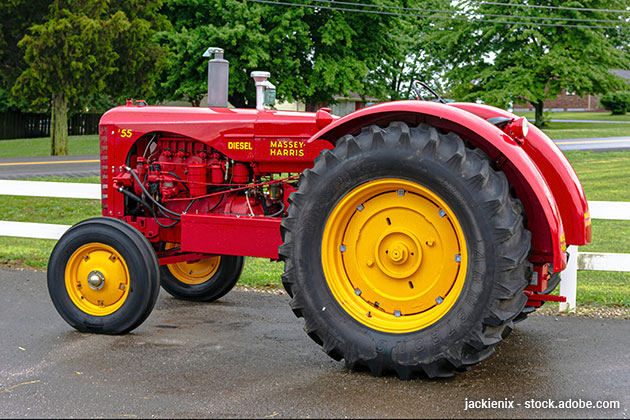
Today, original steel wheels make surviving examples rare, highlighting both the tractor’s age and its lasting value. Many of these machines, remarkably, are still capable of light fieldwork decades later.
The Ferguson System and a New Era of Farming
While Massey-Harris was shaping agricultural machinery in North America, Harry Ferguson was revolutionizing tractor design with his innovative three-point hitch system. This breakthrough dramatically improved safety, efficiency, and implement control, forever changing how tractors worked in the field.
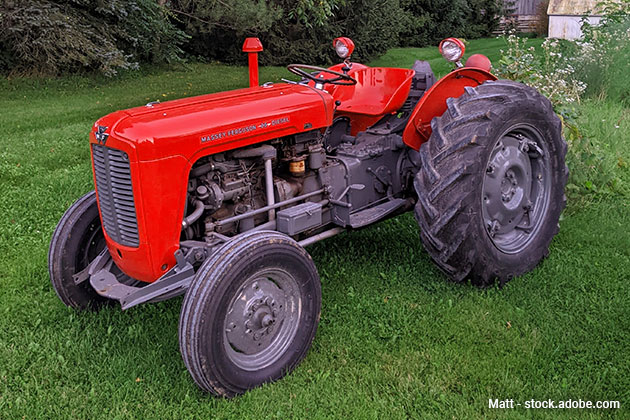
The Ferguson TO-30 (1951–1954) and TO-35 (1954–1960) became symbols of this innovation. Compact yet powerful, these tractors worked countless acres and remained in service long after their production years. Many were retired only after decades of dependable labor, and since restored by fans dedicated to preserving Ferguson’s heritage.
One of the most unusual tractors ever built during this period was the Massey-Harris I-330 (1954). Constructed under contract for the U.S. Navy, only six were produced—and just one is known to survive. They were commissioned for specialized industrial duties at naval air stations, specifically for heavy-duty tasks like pulling railroad cars within naval yards.
The Birth of Massey Ferguson
In the mid-1950s, Massey-Harris and Ferguson merged, officially forming Massey Ferguson. This marked a pivotal moment in agricultural history, blending two powerful legacies into a single global brand.
The Massey-Harris 444 (1956–1958) represents this transition period. Featuring a single front wheel, propane fuel, and a full three-point hitch, it stood at the crossroads of old and new technology. Soon after, the Massey Ferguson name became synonymous with straightforward, dependable machinery.
Tractors such as the Ferguson 40 (1956–1957) and Massey Ferguson Super 90 (1961–1965) demonstrated the company’s expanding lineup and growing presence on family farms.
These machines were built not just for performance, but for longevity—often serving multiple generations of the same family.
Growth, Global Reach, and Iconic Models
By the 1960s and 1970s, Massey Ferguson had established itself as a global leader in tractor manufacturing. Models like the Massey Ferguson 135 and 165 became some of the most recognizable and widely used tractors in the world. Known for their simplicity, fuel efficiency, and ease of maintenance, these tractors found homes on farms large and small.
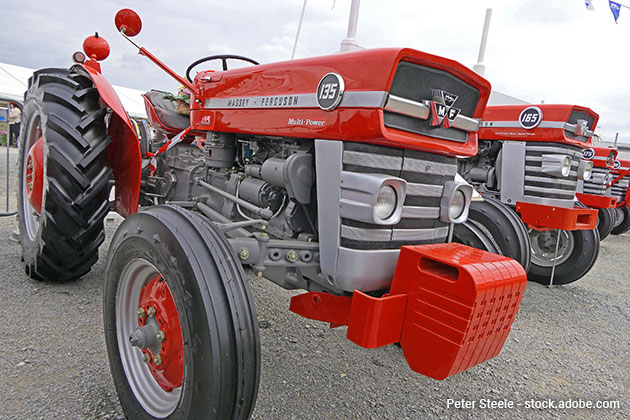
The MF 165 (1964–1975), a particularly rare high-crop version, showcased Massey Ferguson’s ability to adapt machines for specialized farming needs.
During this era, Massey Ferguson also explored unique products beyond traditional tractors. The Ski Whiz 400 SST (1968–1974) reflected the brand’s willingness to innovate and experiment, carrying Massey Ferguson styling into recreational markets.
Power and Progress into the Modern Age
As farming operations grew larger, Massey Ferguson responded with higher-horsepower machines like the MF 1150 (1970–1972). These tractors were built for demanding workloads and often restored decades later by owners who remembered them as the backbone of their family farms.
The brand’s commitment to practical design extended beyond row-crop tractors to garden tractors (1969–1975), which proved invaluable for dairy operations and small-scale farm work.
In the 2000s, tractors such as the Massey Ferguson 8480 (2004–2007) demonstrated how far the brand had come—combining advanced engineering with the same farmer-first philosophy. Whether in the field or in tractor pulling competitions, these machines reflected both heritage and modern performance.
A Legacy Rooted in the Farmer
Today, with a legacy spanning over 175 years and more than a million tractors produced, Massey Ferguson continues to honor its heritage.
The brand’s history is not only told through its machines but also through the fans who have used, restored, and passed them down through generations. An enduring connection between farmer and machine.