Two inductees will be honoured on April 30
By Diego Flammini
Assistant Editor, North American Content
Farms.com
The Norfolk County Agricultural Hall of Fame will welcome two new inductees on April 30.
Ron Judd, a dairy farmer, and David McLaren, a late agricultural journalist, make up the class of 2017.
Ron Judd
Born in Simcoe, 89-year-old Ron Judd lives at Meadow Lynn Farm, which his father purchased in 1946. When not tending to dairy cows and cash crops, Ron volunteered with a number of organizations, including 4-H, Norfolk Soil and Crop Improvement Association and the Norfolk Federation of Agriculture.
He served as president of the Brant-Norfolk Jersey Club, and was honoured with a Jersey Canada lifetime membership in 2011. Judd’s involvement with the Norfolk Land Stewardship Committee exposed him to no-till farming, for which he advocates.
Judd was nominated by his son Fred and daughter-in-law Sharon.
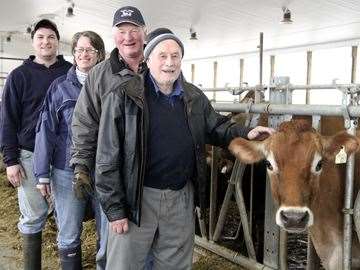
Back to front: Thomas, Sharon, Fred and Ron Judd.
Photo: Meadow Lynn Farms.
David MacLaren
Born in Windsor in 1927, David MacLaren grew up on a tobacco farm near St. Williams. In 1928, the McLaren farm became one of the first to grow flue-cured tobacco.
He eventually took over the farm and his knowledge of the tobacco industry led to the creation of The Tobacco Forum – a column he wrote for the Delhi News Record and The Canadian Tobacco Grower.
He gained a reputation as a leading tobacco writer in Canada.
He was nominated by Bill Moore and will be inducted posthumously.
The induction ceremony takes place Sunday, April 30 at the Waterford Heritage and Agricultural Museum.
Farms.com extends its congratulations to the Judd and MacLaren families!