Farms.com Home   Ag Industry News

Viterra officially opens Ste. Agathe grain terminal

Manitoba is home to a number of Viterra terminals

By Diego Flammini
Assistant Editor, North American Content
Farms.com

Viterra officially opened its new high throughput grain terminal in Ste. Agathe, Manitoba.

The facility, which joins many others situated throughout the province, has 30,000 tonnes of grain storage and can load 134 railcars. A loop track can connect to CN and BNSF railway lines.

"We're very pleased with this highly efficient facility and what it will mean to farmers, suppliers and other stakeholders in this province and in this community," Kyle Jeworski, Viterra president and CEO, said in a release. "We also recognize that any success we have as a company is directly attributed to our customers, who choose to trust us, to support us, and to provide us with the quality products we need to meet our end users' expectations worldwide."
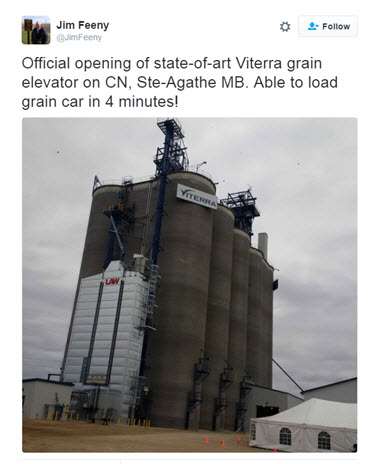

Viterra's new grain terminal in Ste. Agathe, Manitoba.
Photo: Jim Feeny/Twitter

Jeworski said despite the company’s long history in the province, the new facility represents what the future has in store for Manitoba agriculture.

"While we're very proud of our history, we're also firmly focused on the future. Our significant investment in this new grain terminal demonstrates our confidence that southern Manitoba will continue to play an important role in Canadian and global agriculture for many more years to come."


Trending Video

Finding a Balance of Innovation and Regulation - Dr. Peter Facchini

Video: Finding a Balance of Innovation and Regulation - Dr. Peter Facchini

Regulations help markets and industry exist on level playing fields, keeping consumers safe and innovation from going too far. However, incredibly strict regulations can stunt innovation and cause entire industries to wither away. Dr. Peter James Facchini brings his perspective on how existing regulations have slowed the advancement of medical developments within Canada. Given the international concern of opium poppy’s illicit potential, Health Canada must abide by this global policy. But with modern technology pushing the development of many pharmaceuticals to being grown via fermentation, is it time to reconsider the rules?

Dr. Peter James Facchini leads research into the metabolic biochemistry in opium poppy at the University of Calgary. For more than 30 years, his work has contributed to the increased availability of benzylisoquinoline alkaloid biosynthetic genes to assist in the creation of morphine for pharmaceutical use. Dr. Facchini completed his B.Sc. and Ph.D. in Biological Sciences at the University of Toronto before completing Postdoctoral Fellowships in Biochemistry at the University of Kentucky in 1992 & Université de Montréal in 1995.